過去の制約から未来を想像する – MotivMfg / Imagining the Future Through the Limitations of the Past – MotivMfg
2026.7.12
MotivMfgのデニムウェアを見ていると、単に古いジーンズを再現したものではないことが分かります。
そこにあるのは、ヴィンテージという「物」への憧れだけではなく、ワークウェアがまだ一人ひとりの職人の技術や判断によって支えられていた時代への視線です。
今回は、7月に東京でバイヤー向けの展示会を開催するMotivMfg(以下、Motiv)についてご紹介します。
Motivでは、デザイナーのDanielさんが、テーラーとして培った経験をもとに、すべてのコレクションのパターンを自ら設計しています。
多様な洋服を展開するブランドですが、今回は特にデニムウェアのコレクションを中心にご紹介します。
ブランド史の陰にある、服づくりの歴史
ジーンズの歴史は、しばしばLevi’sを起点とするブランドの歴史として語られます。
1873年、Levi Strauss & Co. はヤコブ・デイビスとともに、ポケットなどの負荷がかかる箇所をリベットで補強する特許を取得しました。
それ以降、Levi’sはジーンズという存在を広く知らしめるうえで、大きな役割を果たしていきました。
その後、Lee、さらに後年に登場するWranglerなども含め、ジーンズはアメリカ全土へ流通し、一つの産業として確立されていきました。
しかし、ジーンズやワークウェアの歴史を、ブランドや製品の変遷としてだけ見てしまうと、見えなくなるものがあります。
それは、服づくりそのものの歴史です。
現在では、服づくりは多くの場合、ブランドという枠組みと結びつけて語られているのではないでしょうか。
しかし、かつてのアメリカでは、現在のように全国規模でブランド名が認知される以前から、地域に根ざした衣料商や仕立て屋、小さな工房が存在し、その土地で働く人々のために服をつくっていました。
多くの服は地域の中でつくられ、使われ、やがて歴史の中へ消えていったのだと思います。
そのため、作り手の名も資料も、現在ではほとんど残っていません。
けれど、歴史に名を残さなかった服づくりの中にこそ、ワークウェアの根源的な姿があったのではないかと思います。
Motivが見つめているのは、まさにそのような時代の感覚です。
テーラリングと工業生産のあいだ
Samuelさんは、Motivのデニムの縫製技術について、1890年代から1930年代にかけてのデニムワークウェアに非常に近いと語っています。
この時代は、アメリカのワークウェアが工業製品として急速に規格化されていく過程にありました。
その一方で、地域には仕立て屋や小規模な工房が残り、それぞれの技術や経験、判断が、服の縫製や構造に反映されていました。
工場による規格化と、テーラーによる仕立て。
その二つが同じ時代に存在していた、移行期です。
ここで重要なのは、Motivのデニムを、伝統的なアメリカンジーンズの延長としてだけ捉えないことです。
Samuelさんは、Motivのデニムについて、典型的なアメリカンジーンズというよりも、むしろテーラリングの技術が残る、かつてのヨーロッパのワークウェアに近いと語っています。
この言葉は、Motivを理解するうえで重要だと思います。
デニムという素材を用いながらも、一般的な5ポケットジーンズの型をなぞるのではない。
テーラリングの技術とワークウェアの構造、そして工業的な縫製技術を交差させながら、一着の服として構築していく。
その姿勢こそが、Motivが一貫して大切にしてきた服づくりなのだと思います。
Motivが見つめているのは、単にヴィンテージという「物」ではありません。
残された一着をそのまま複製することではなく、その一着が生まれる以前にあった服づくりの考え方。
地域の仕立て屋や小さな工房が、目の前の労働者のために、限られた技術と環境の中でどう服を考え、どう仕立てていたのか。
その思想そのものです。
Samuelさんは、Motivのデニムコレクションについて、縫製技術は当時の古いデニムワークウェアに近い一方で、パターン設計は実際のヴィンテージよりもはるかに複雑だと語っています。
それは、過去の服をそのまま再現するためではありません。
「過去の限られた技術の中で、何ができたのか」
その原則から想像されたもの。
あるいは、とても古い時代から見た、未来的な解釈。
Motivのデニムウェアには、そのような独特の時間感覚が存在します。
古い服をなぞるのではなく、古い時代の技術や制約、思想を起点に、現代の洋服を生み出しているのです。
では、その思想が実際の服にどのように表れているのか、2026年6月に開催されたパリのショールームから、デニムコレクションを見ていきます。
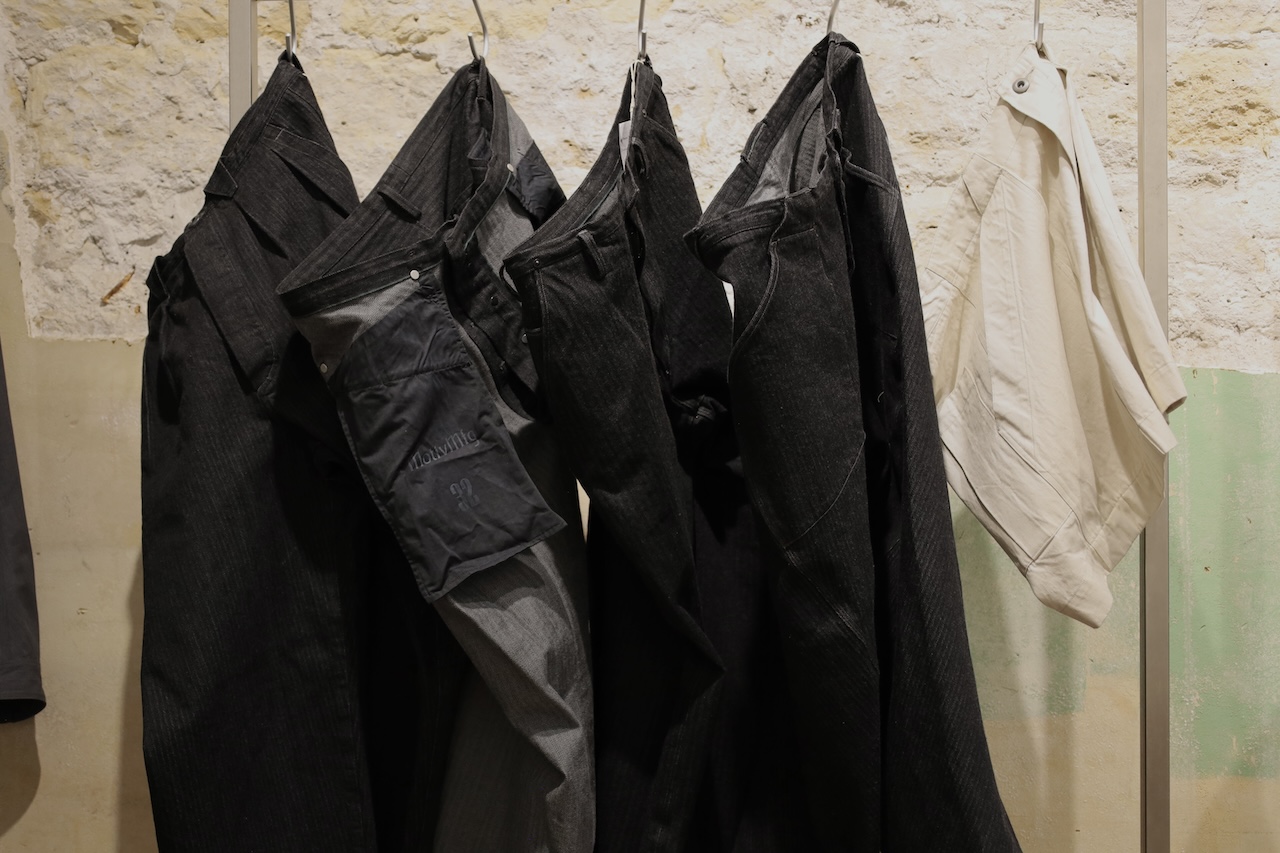
Original Herringbone Denim
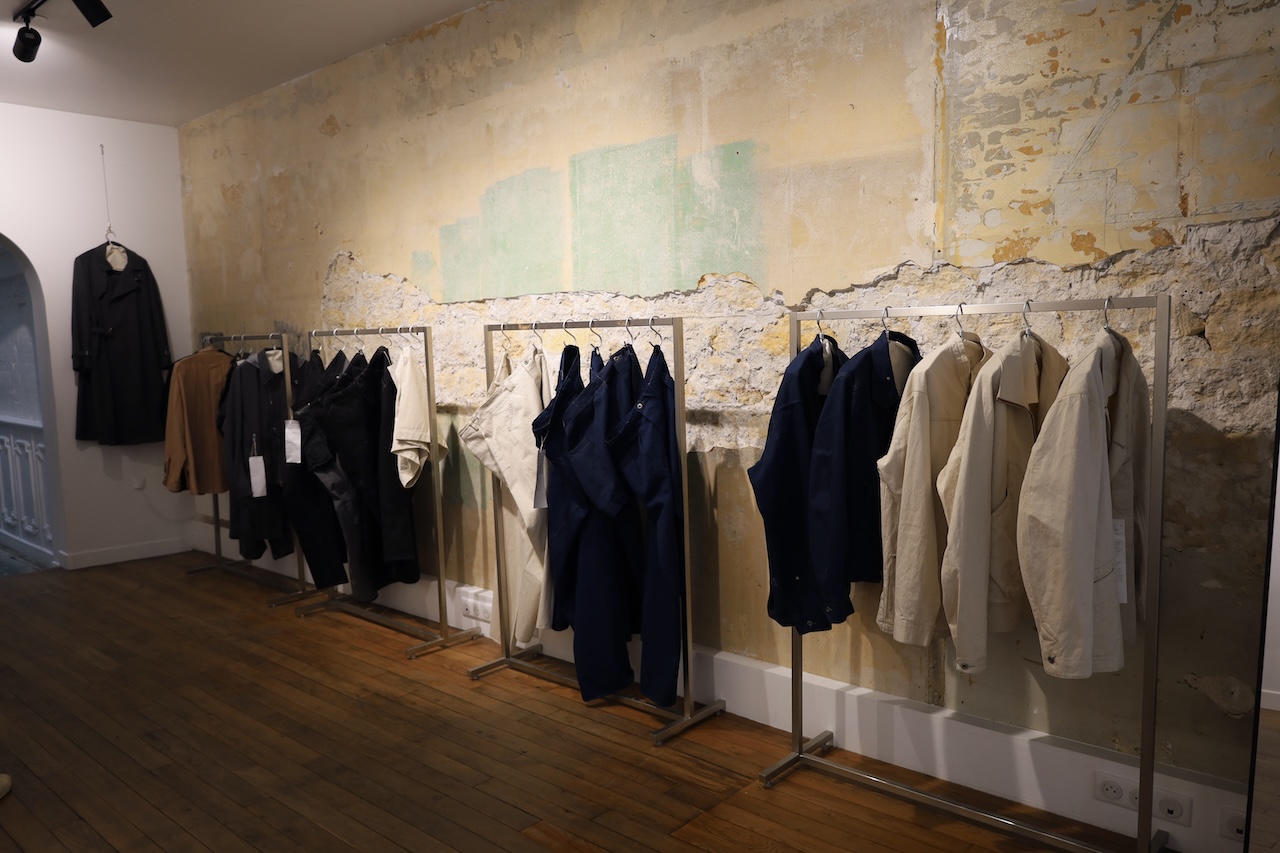
ショールームに並んだデニムコレクション。
Motivには、ブランドを象徴する生地の一つとして、Original Herringbone Denimがあります。
これは、中国の優れたセルヴィッチデニムの織り手たちとともに開発され、1950年代の特殊なドビー織機によって織り上げられる生地です。
Samuelさんによれば、そのセルヴィッチデニムを織る織機は、日本の豊田式織機にも非常に近い構造を持つものとのことです。
通常のデニムとは異なるヘリンボーン組織によって、生地の表情には独特の立体感があります。
ブラックの経糸には硫化染色が用いられており、着用を重ねることで、インディゴデニムのように少しずつ色が抜け、風合いにも奥行きが生まれていきます。
さらに、この生地には防縮加工が施されていないため、最大13%の縮みが生じる可能性があるとされています。
製品にはあらかじめワンウォッシュが施され、着用後の大きな縮みが抑えられています。
ヘリンボーン組織は、単に見た目のためだけではなく、洗いで生じる生地の捻れを均す役割も持っていると説明されています。
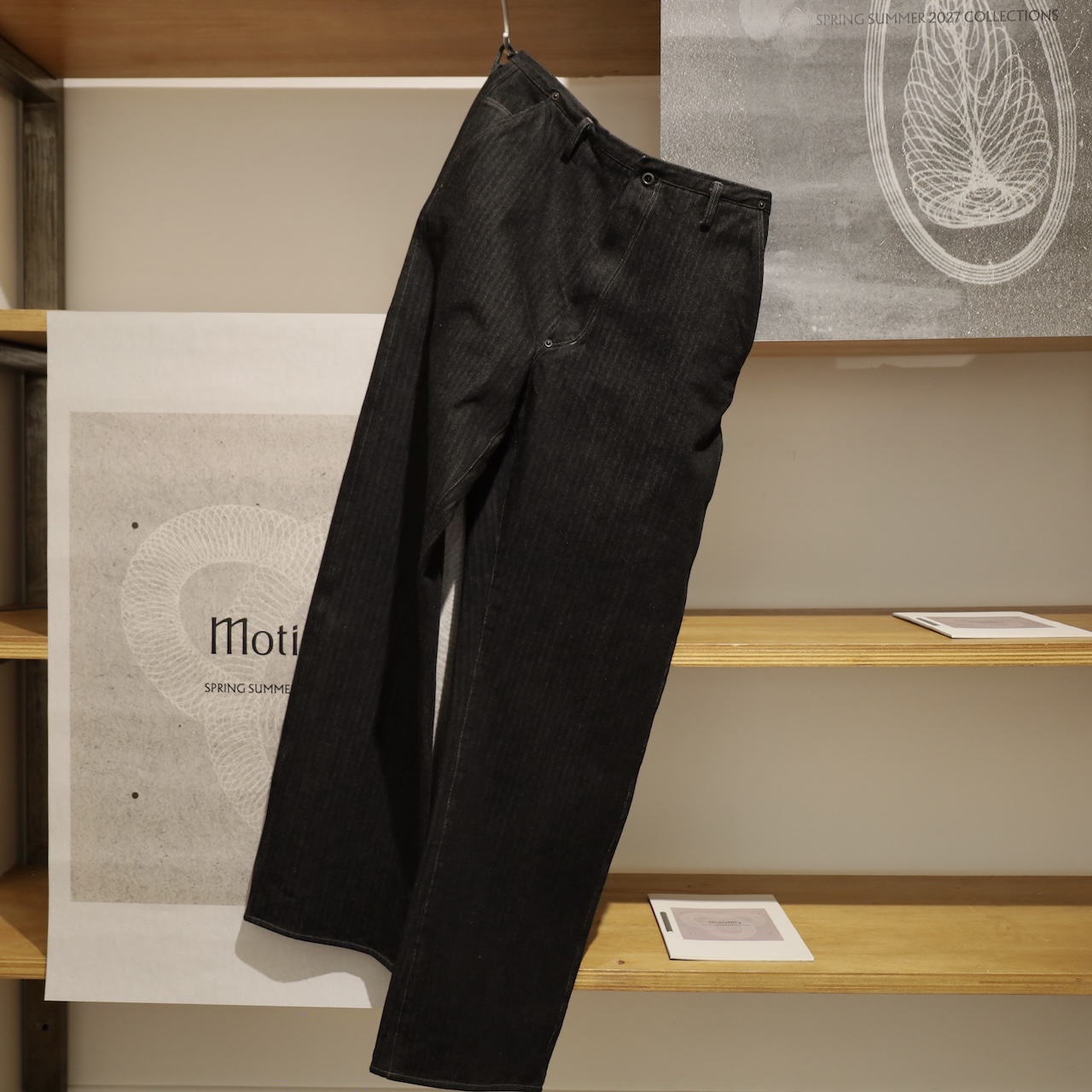
こちらは、Uni Denim Trousersというモデル。
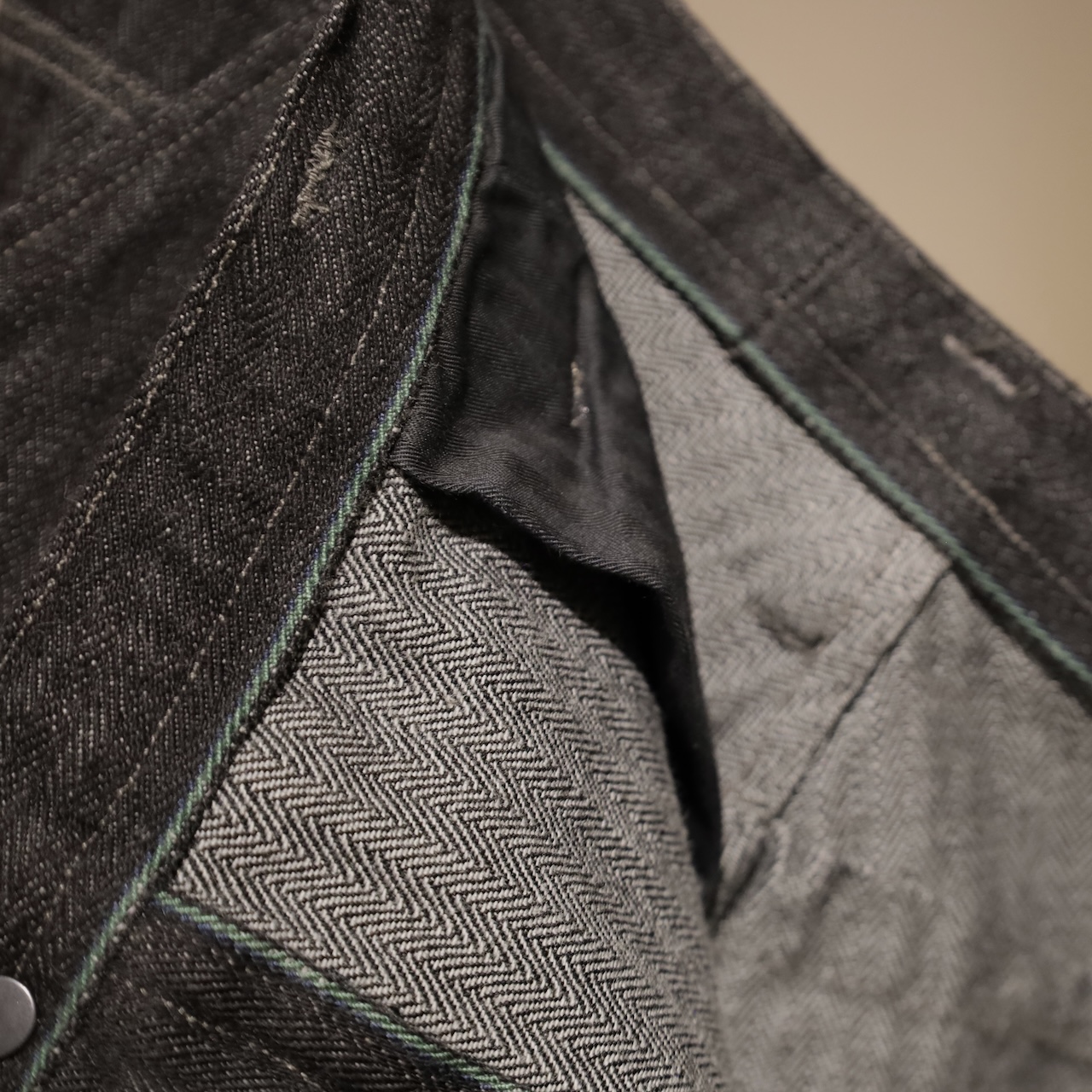
ヘリンボーン組織と緑色のセルヴィッチも特徴的です。
また、生地だけではなく、古い時代の技術や制約、思想を反映した縫製仕様にも大きな特徴があります。
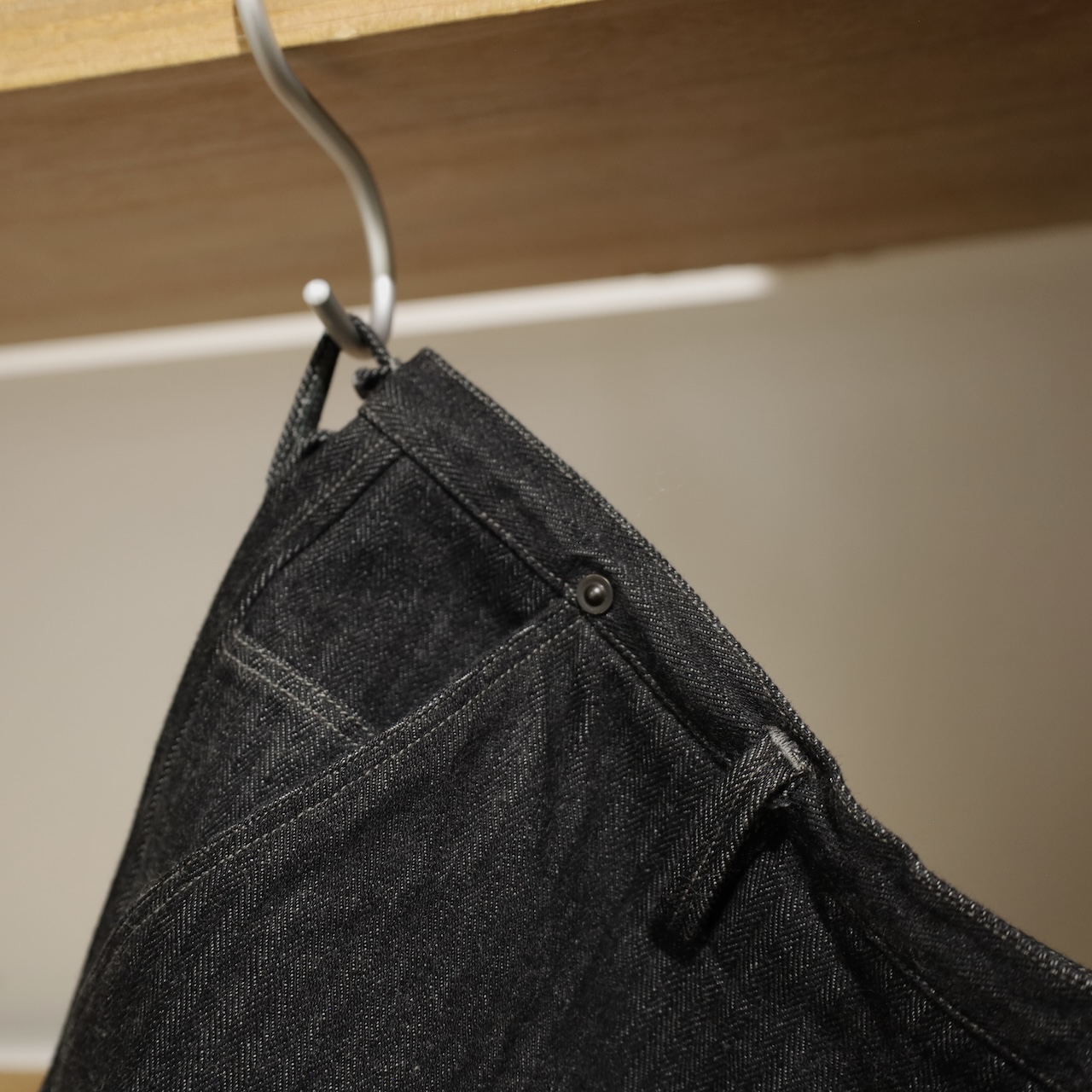
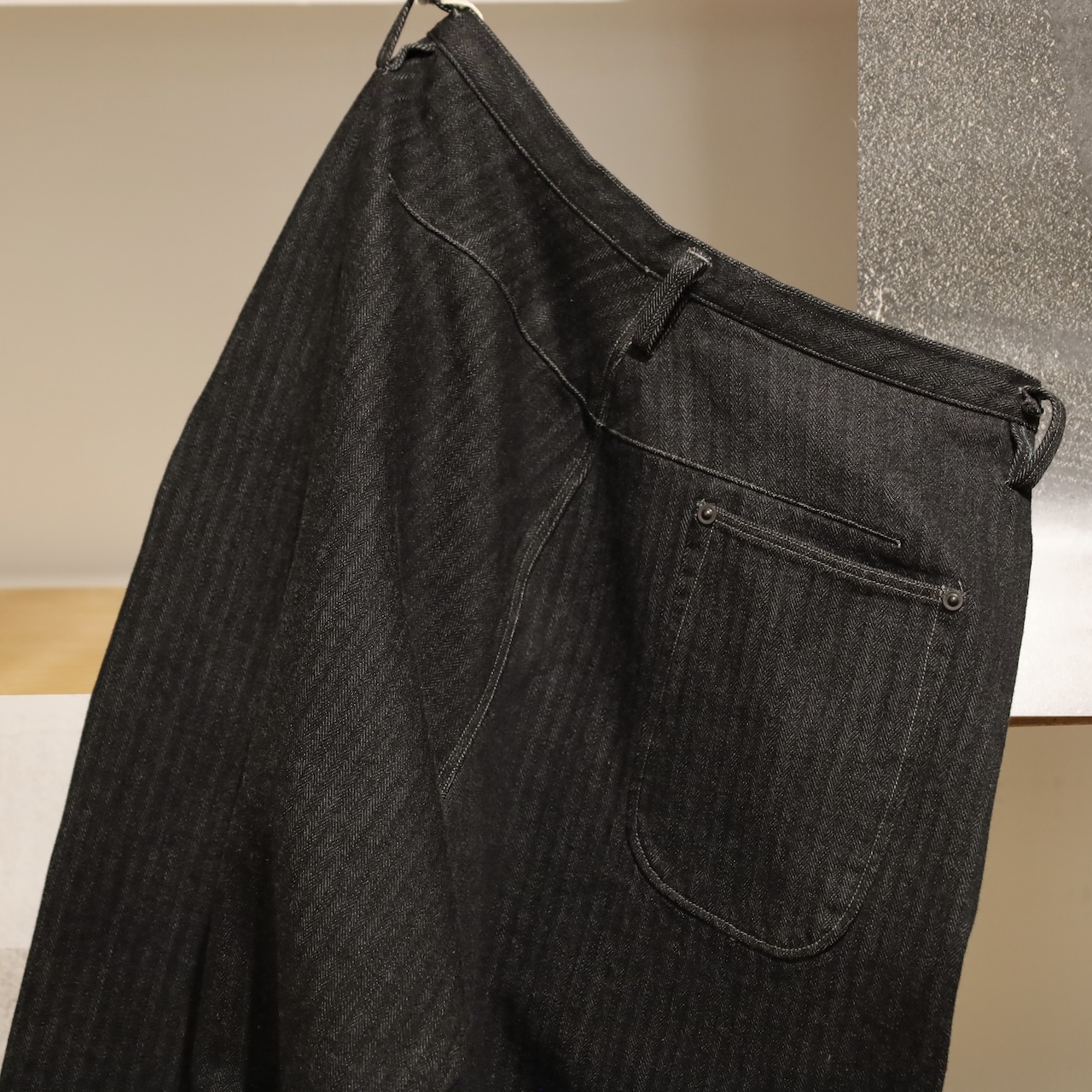
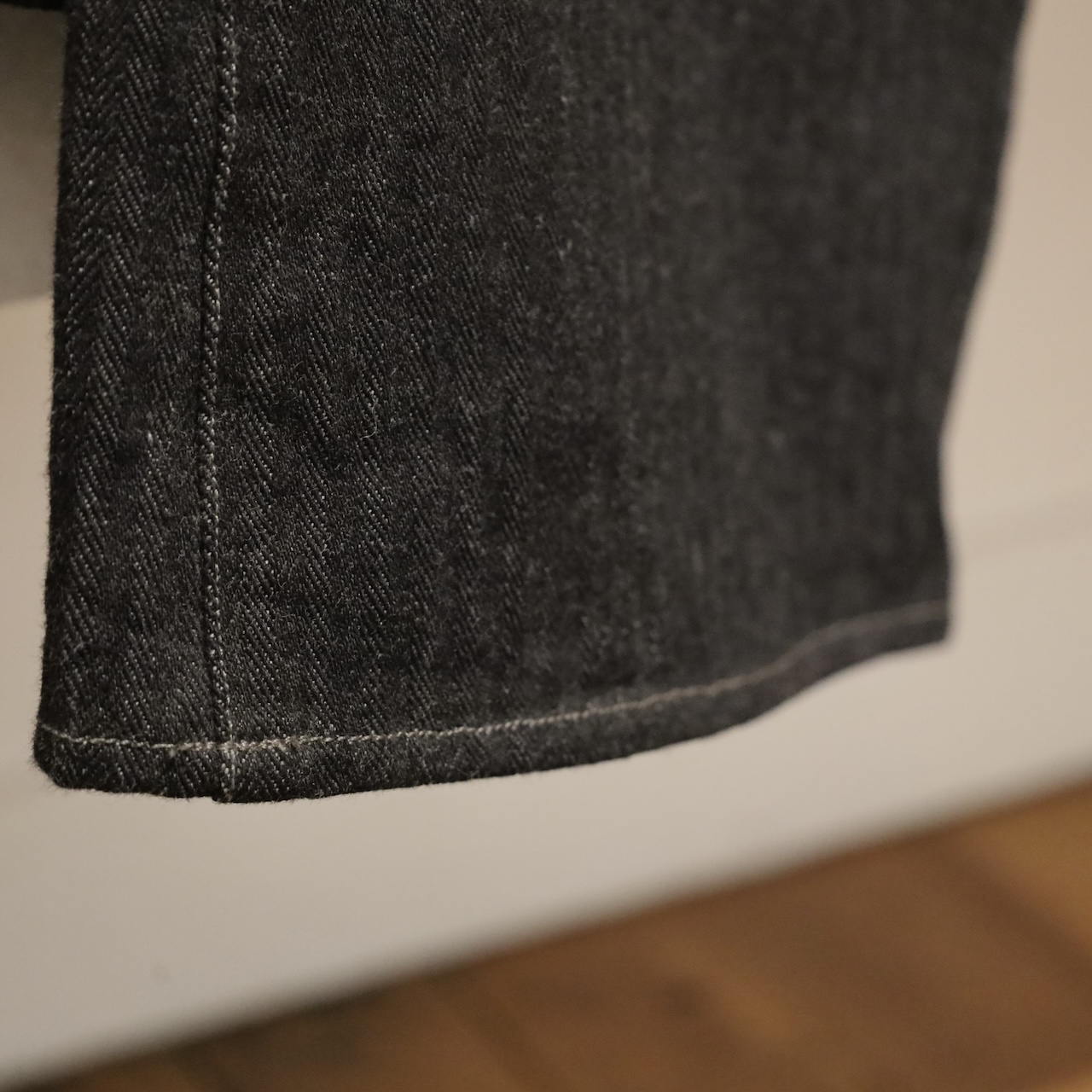
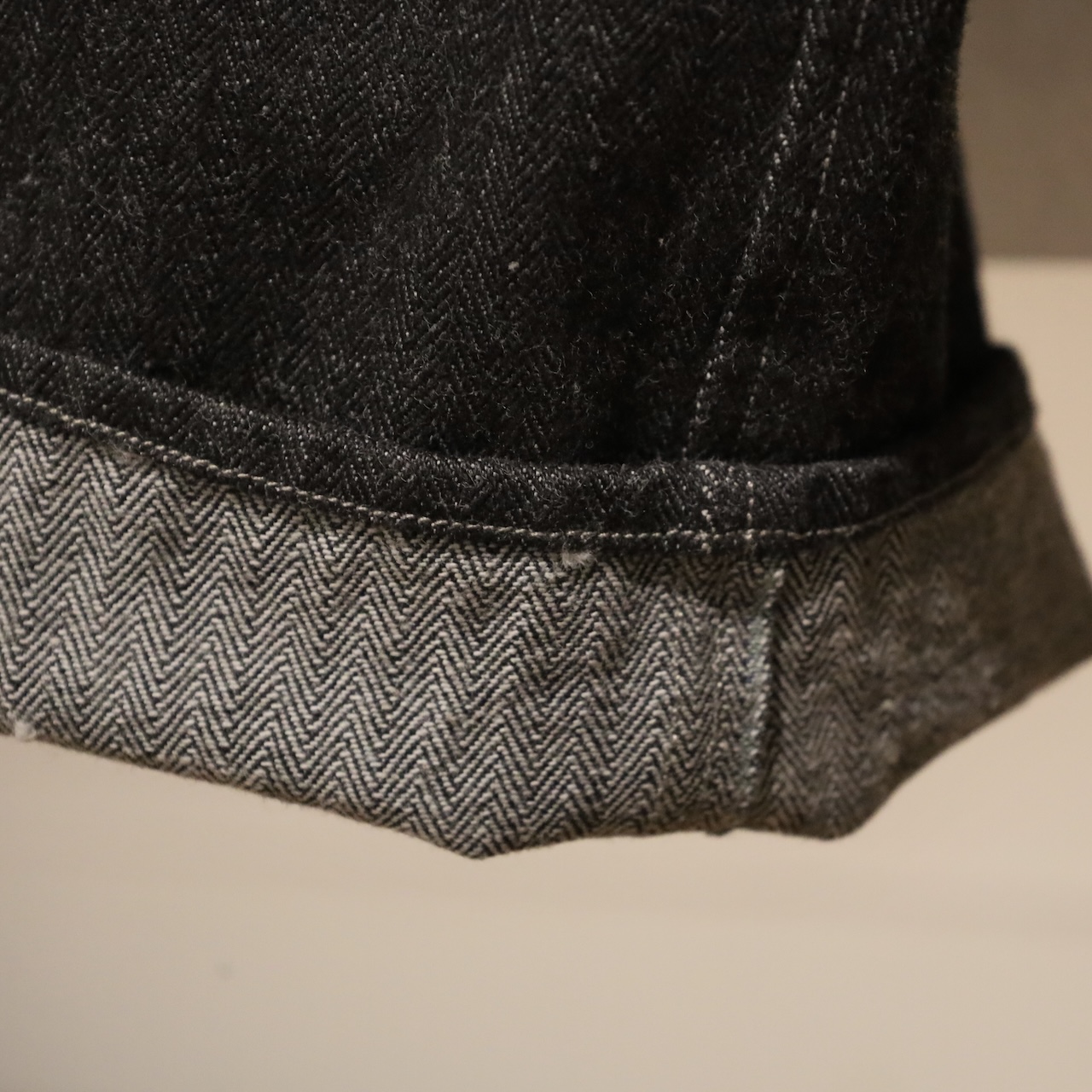
Motivのデニムを見ていると、ここまで細かく、端正に縫い上げられたデニム製品は、そう多くはないと感じます。
また、Motivのデニムは、ほとんどの箇所が一本針本縫いで縫い上げられています。
現代の量産デニムやワークウェアでは、効率や強度、工程の安定性を考え、巻き縫いやチェーンステッチが多く用いられます。
しかしMotivでは、あえて一本針本縫いを多用しています。
1890年代から1930年代にかけてのデニムワークウェアには、一本針本縫いによって細かく縫い上げられたものが多く見られます。
一本針で縫うということは、非常にシンプルでありながら、制約の多い縫製でもあります。
縫い代の収め方、生地の重なり、ステッチの入り方に、より明確な判断が求められます。
そこには、効率化された量産のための縫製とは異なる、一着の服をどう成立させるかという職人的な感覚が欠かせません。
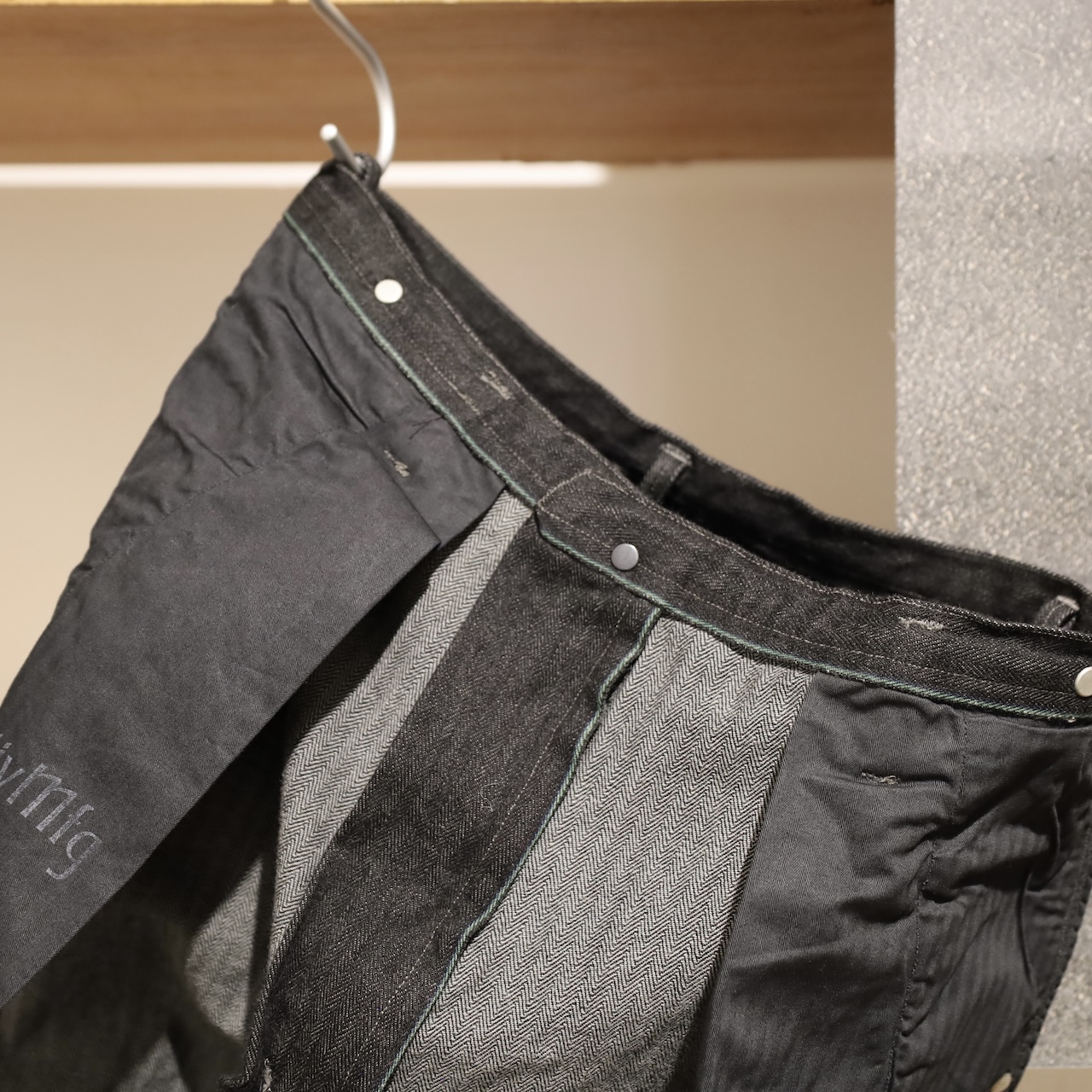

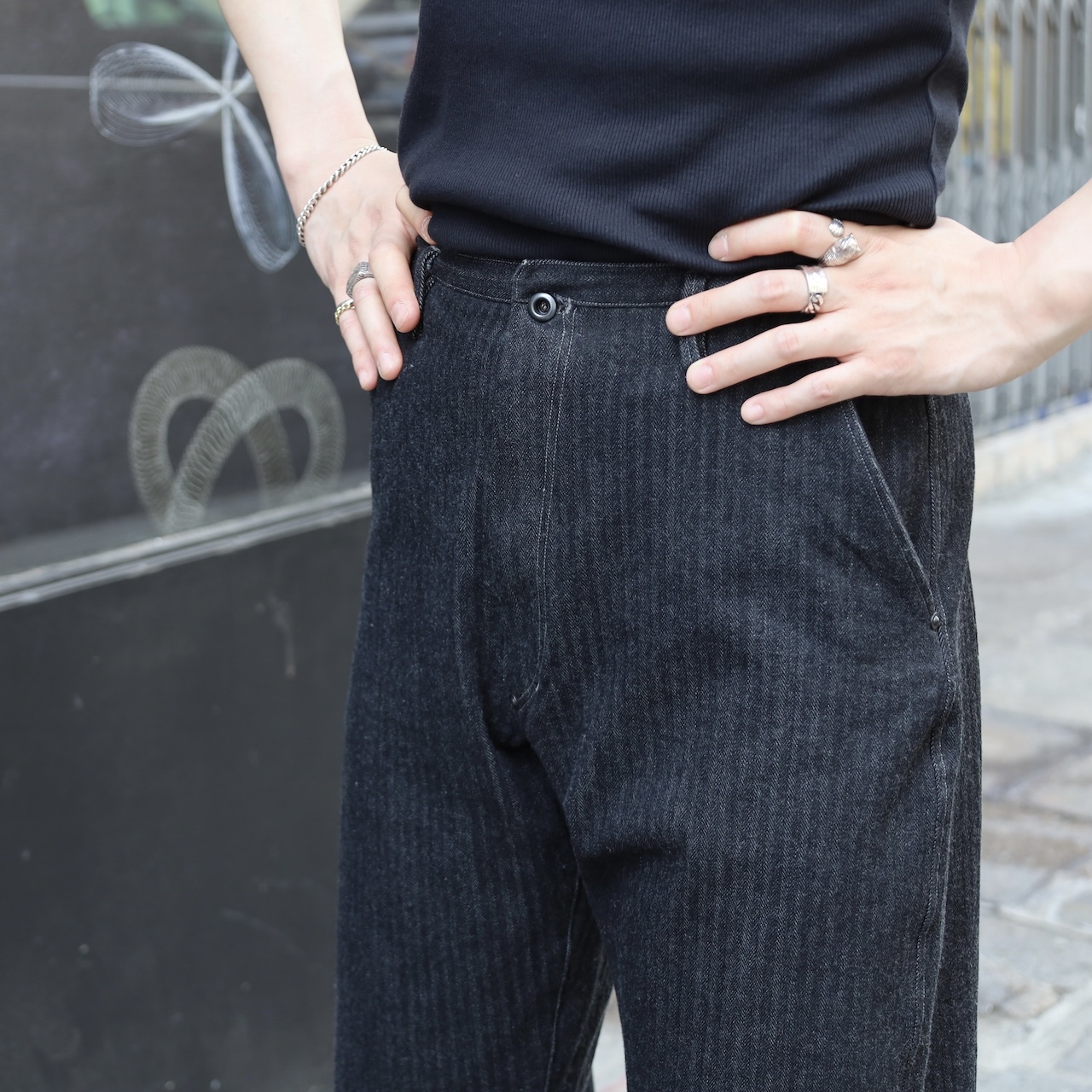
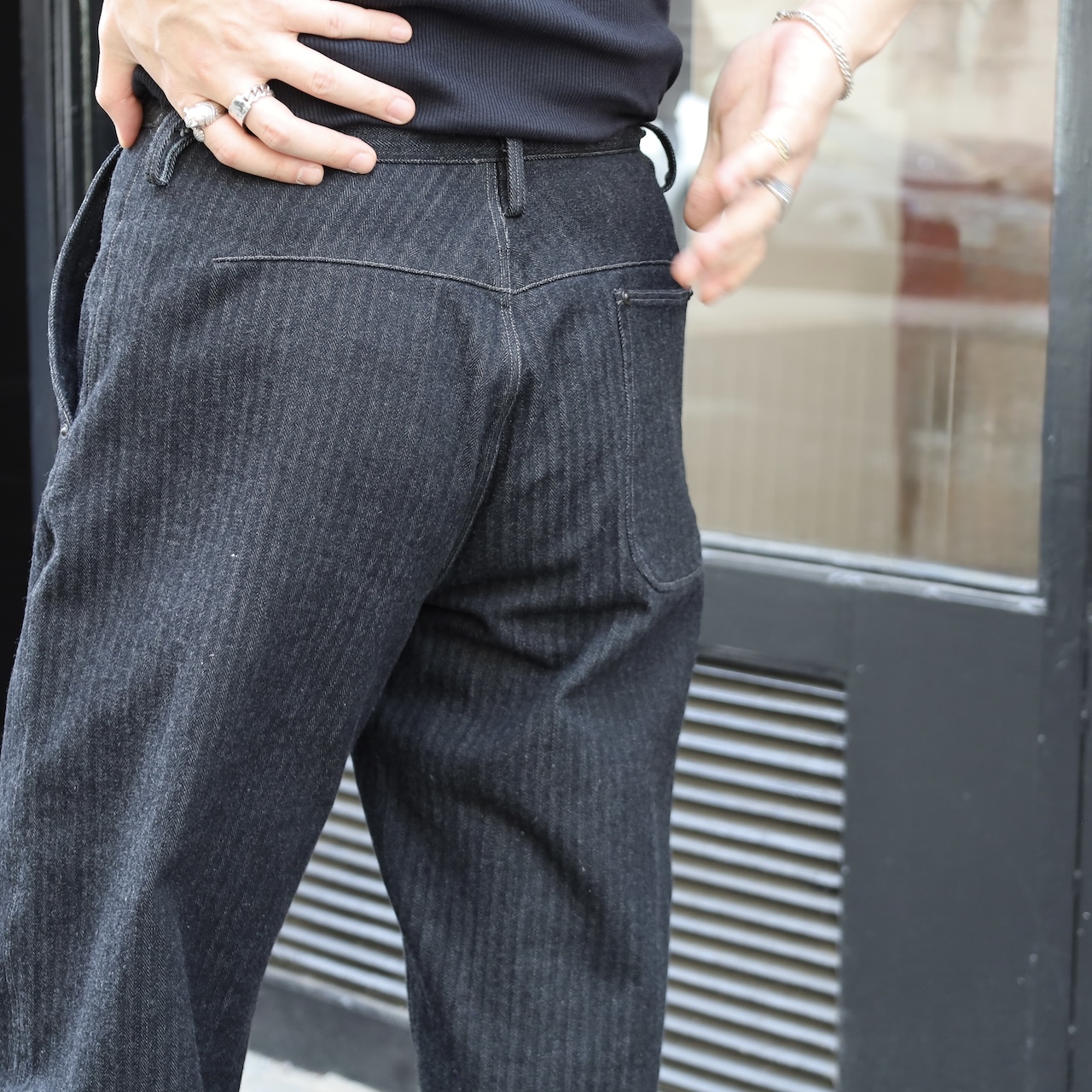
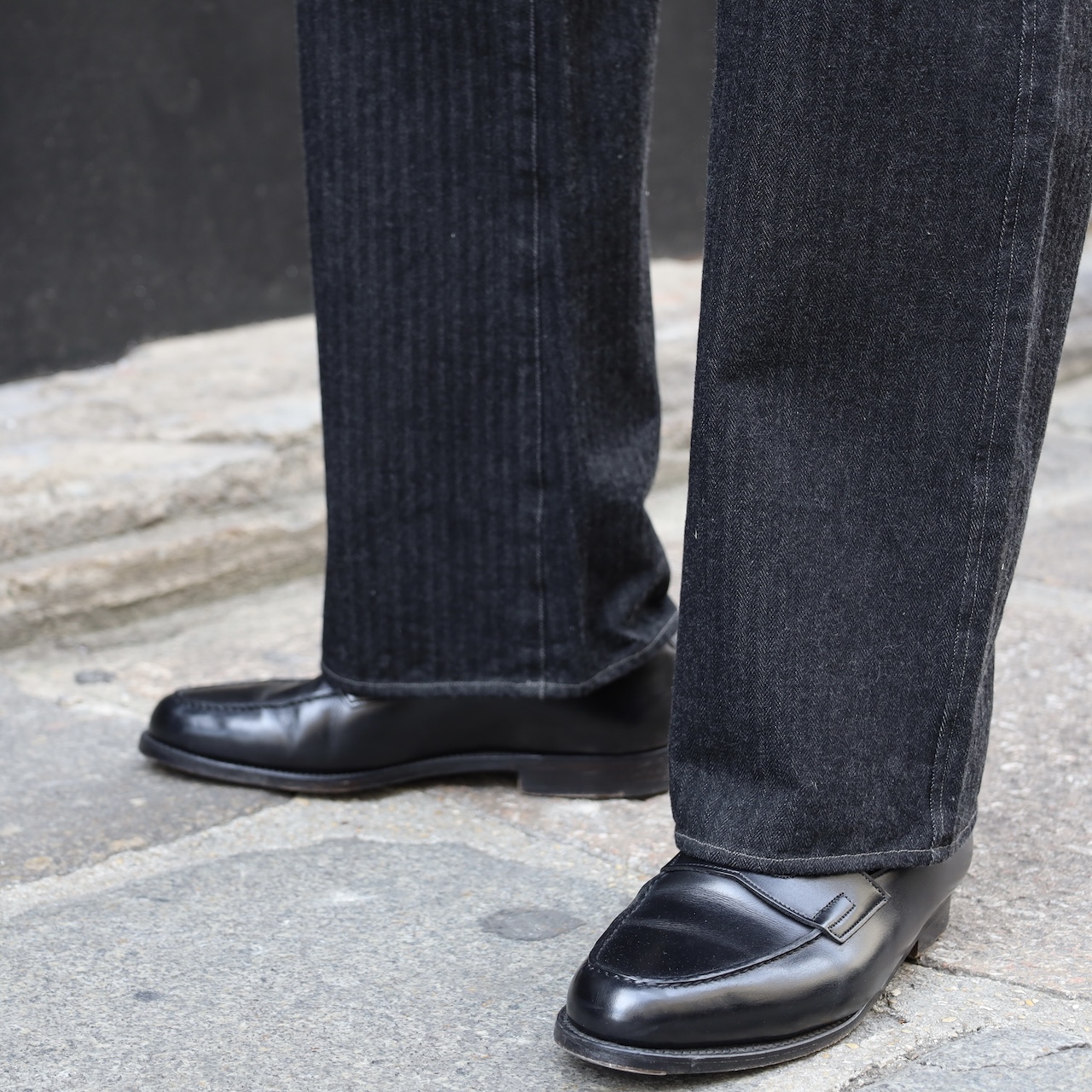
僕自身、この細かな運針には、見た目の美しさだけではなく、服全体の佇まいを引き締めるような魅力を感じます。
デニムをはじめ、テーラリングやミリタリーを基調とした布帛アイテムの多くは、北京郊外に位置する自社アトリエで仕上げられています。
そこには、かつて国営工場でサンプル縫製を担っていた8名の職人たちが在籍しています。
その国営工場が閉鎖された後、Motivはサンプリングチーム全員を自社に迎え入れ、チームをそのまま維持しました。
サンプルを縫うという仕事には、単に仕様通りに手を動かすだけではなく、素材の特性を読み、構造を理解し、服としての完成度を判断する力が求められます。
Motivの服には、そうした職人たちの経験と判断が、縫製の中に残っています。
Motivが行っているのは、単にヴィンテージと同じ構造の服を作ることではありません。
古い時代の服づくりに存在していた制約や判断、そして職人の手の中にあった可能性を、現代の服としてもう一度組み立てようとしているのだと思います。
数多くのデニム製品が存在する現在においても、自社アトリエでこうした服づくりを続けるMotivには、明確な独自性があります。
職人の経験と判断によって成り立つ以上、簡単に再現できるものではありません。
Motivのデニムコレクションを見ていると、デニムを単なる素材やディテールの集合ではなく、ワークウェアがどのような思想によってつくられてきたのかという視点から捉えることができます。
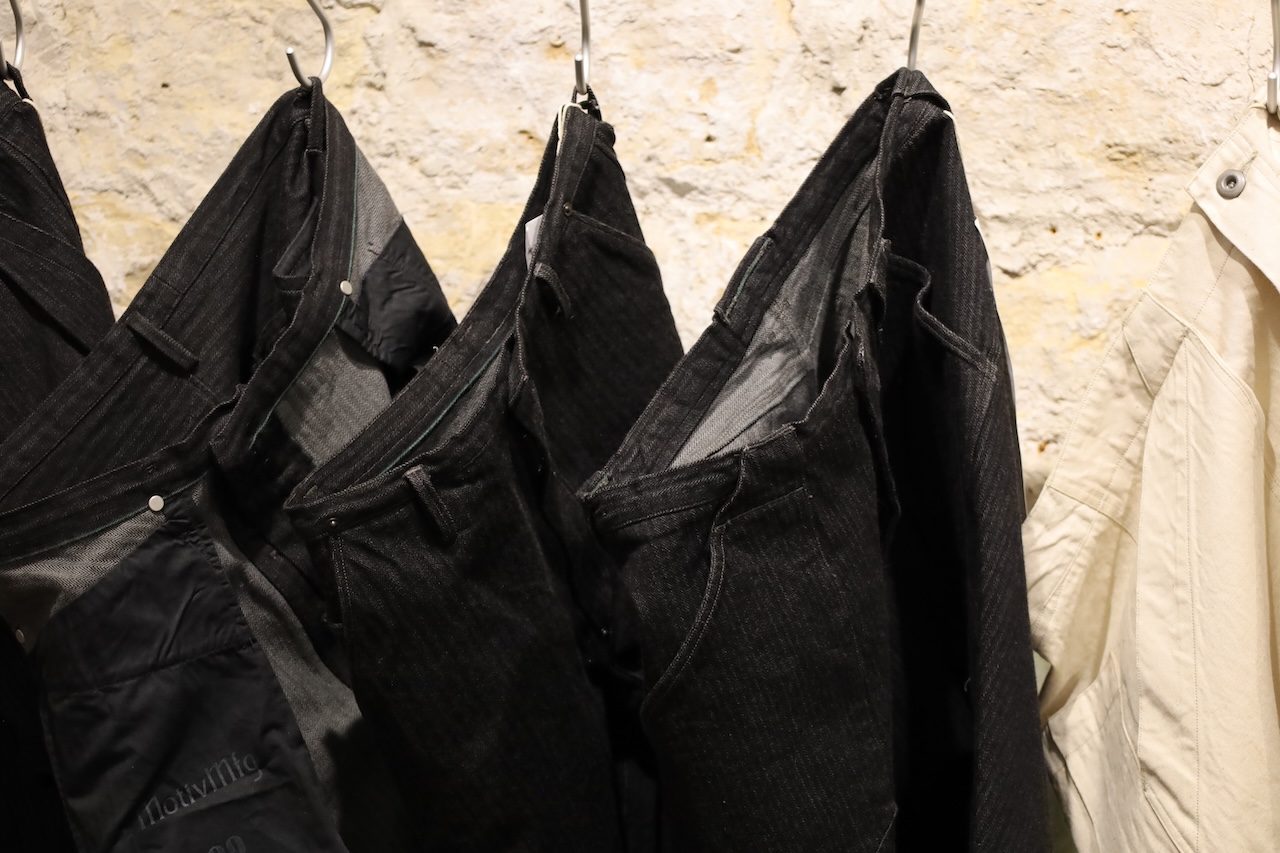
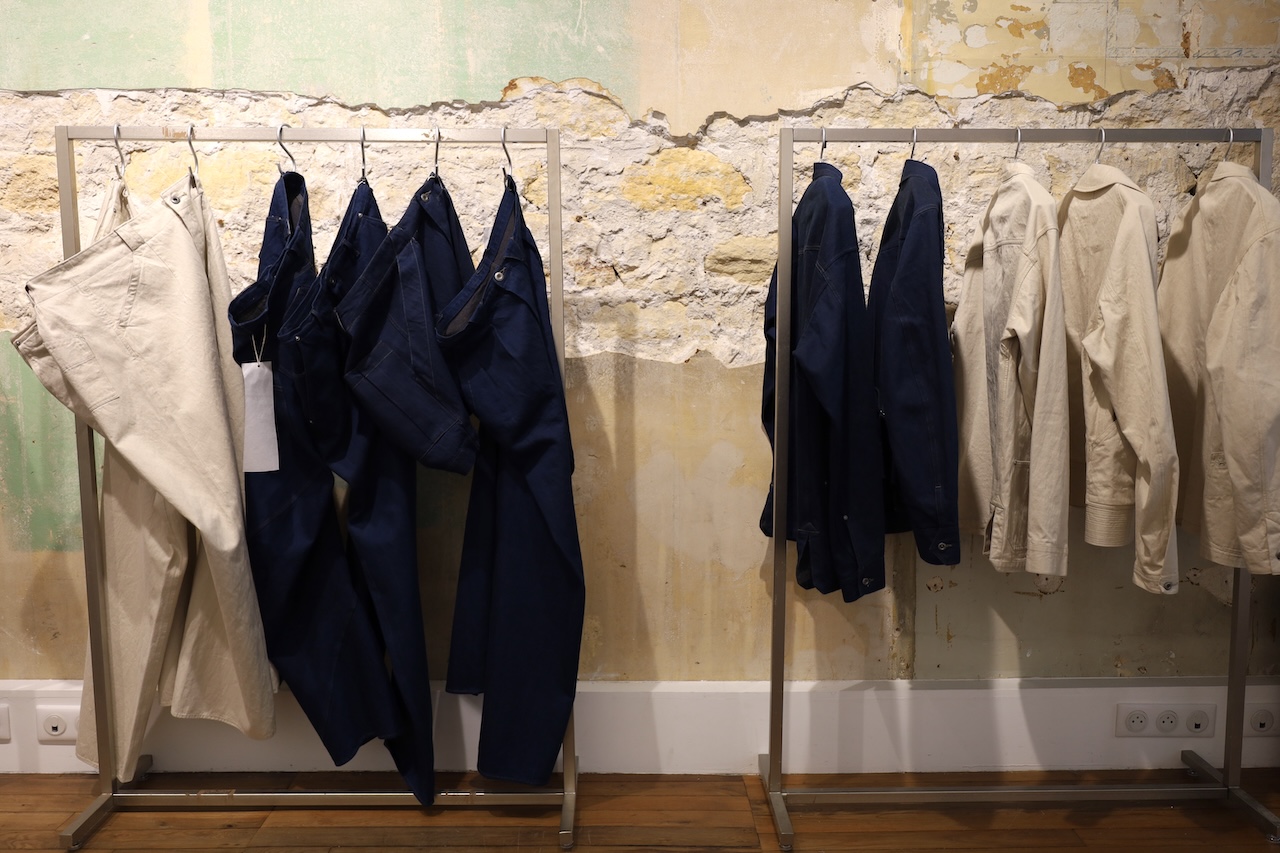
Original Herringbone Denim だけではなく、シーズナルで生地が変わるデニムコレクションも同時に存在します。
デニムを越えて広がるコレクション
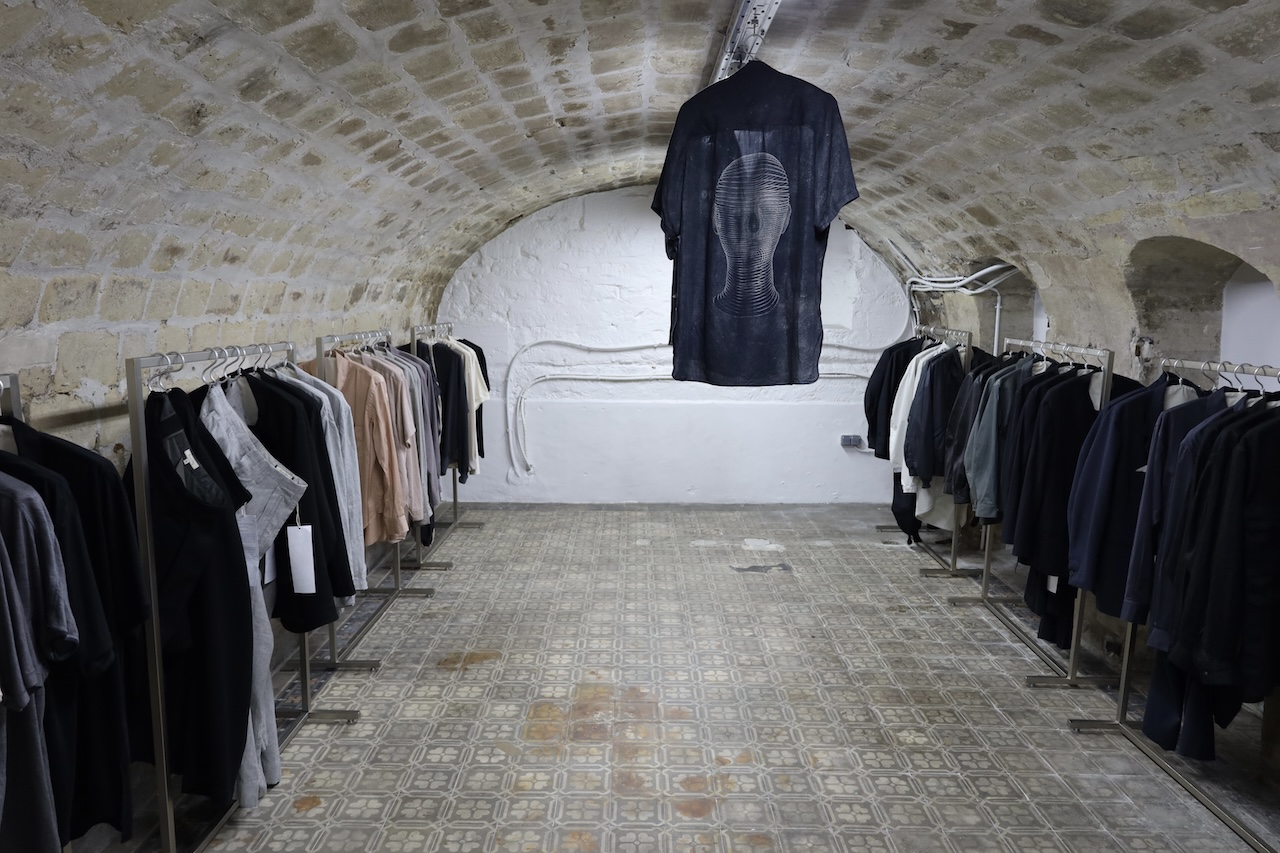
Motivのコレクションは、デニムだけではありません。
テーラードジャケットやトラウザーズ、シャツ、テクニカルウェア、レザーウェアまで、多様なアイテムを展開しています。
そこには、Motivが蓄積してきた服づくりの引き出しが表れています。
シャツにもさまざまなバリエーションがありますが、今回、僕が特に印象に残ったのは二つの生地でした。
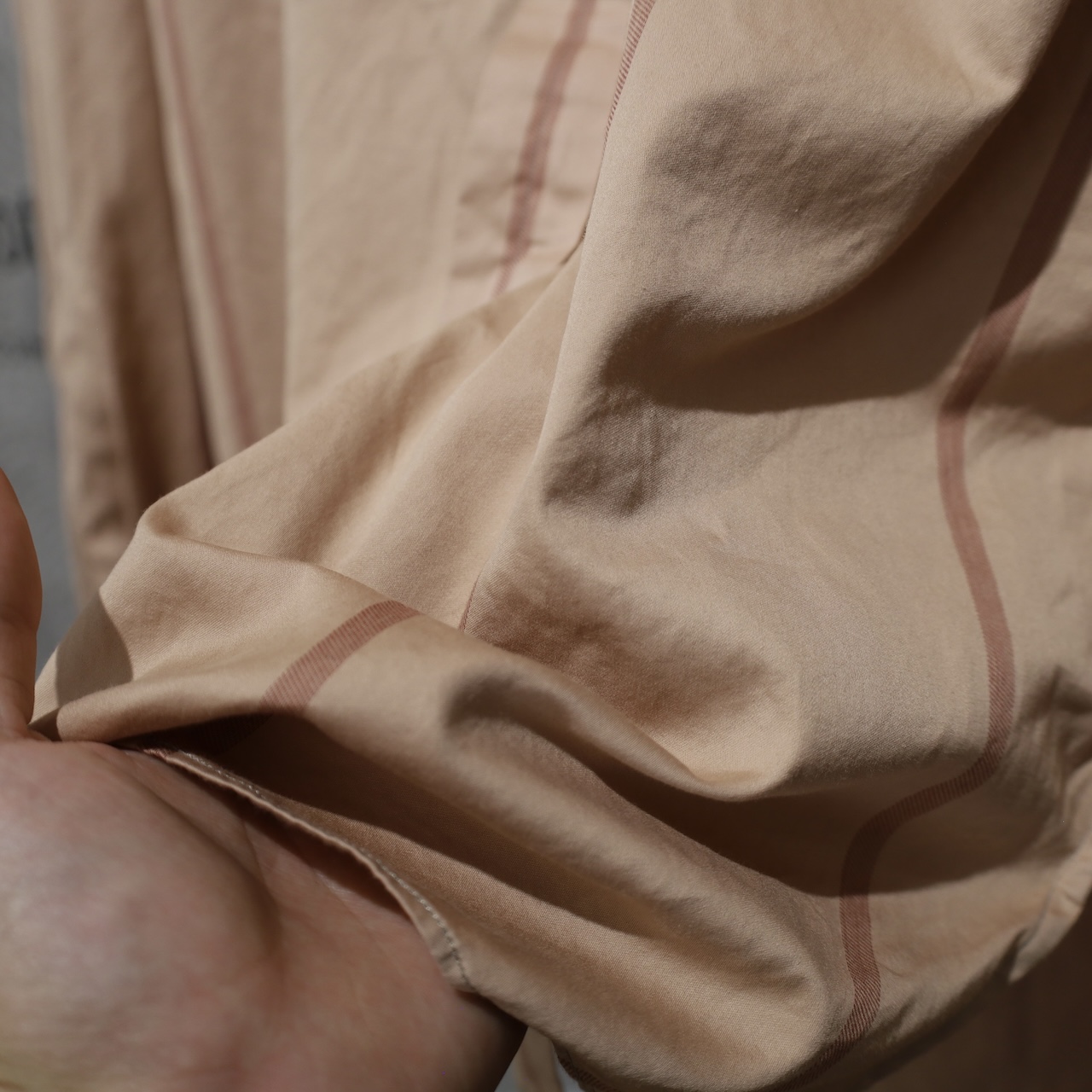
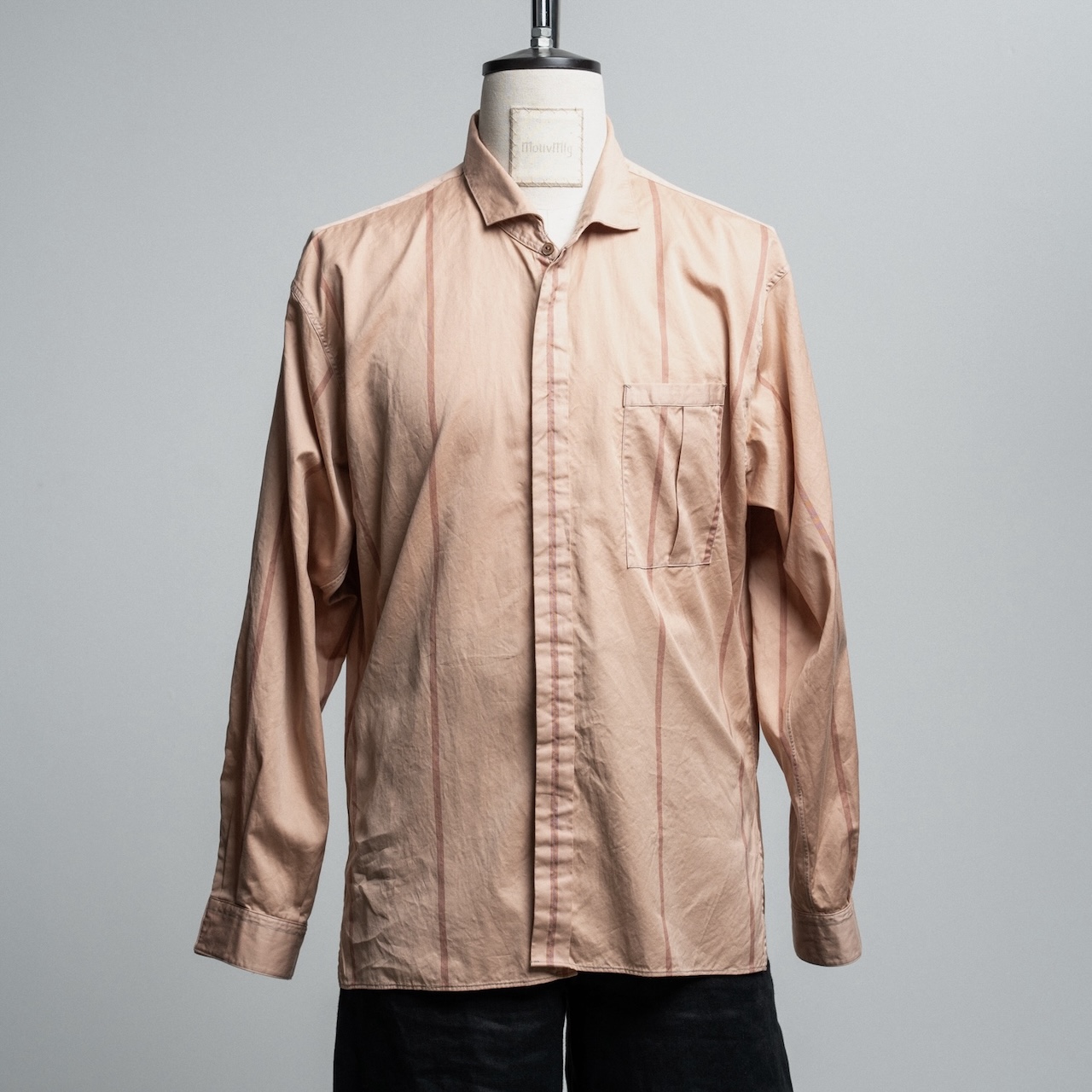
一つは、2-Ply 180s Sateen Shirting。
180番手双糸によるサテン生地で、肌あたりのなめらかさ、生地表面のキメ細かさ、そして控えめな光沢が印象的でした。
幅広のストライプでありながら、強く主張しすぎない上品さがあります。
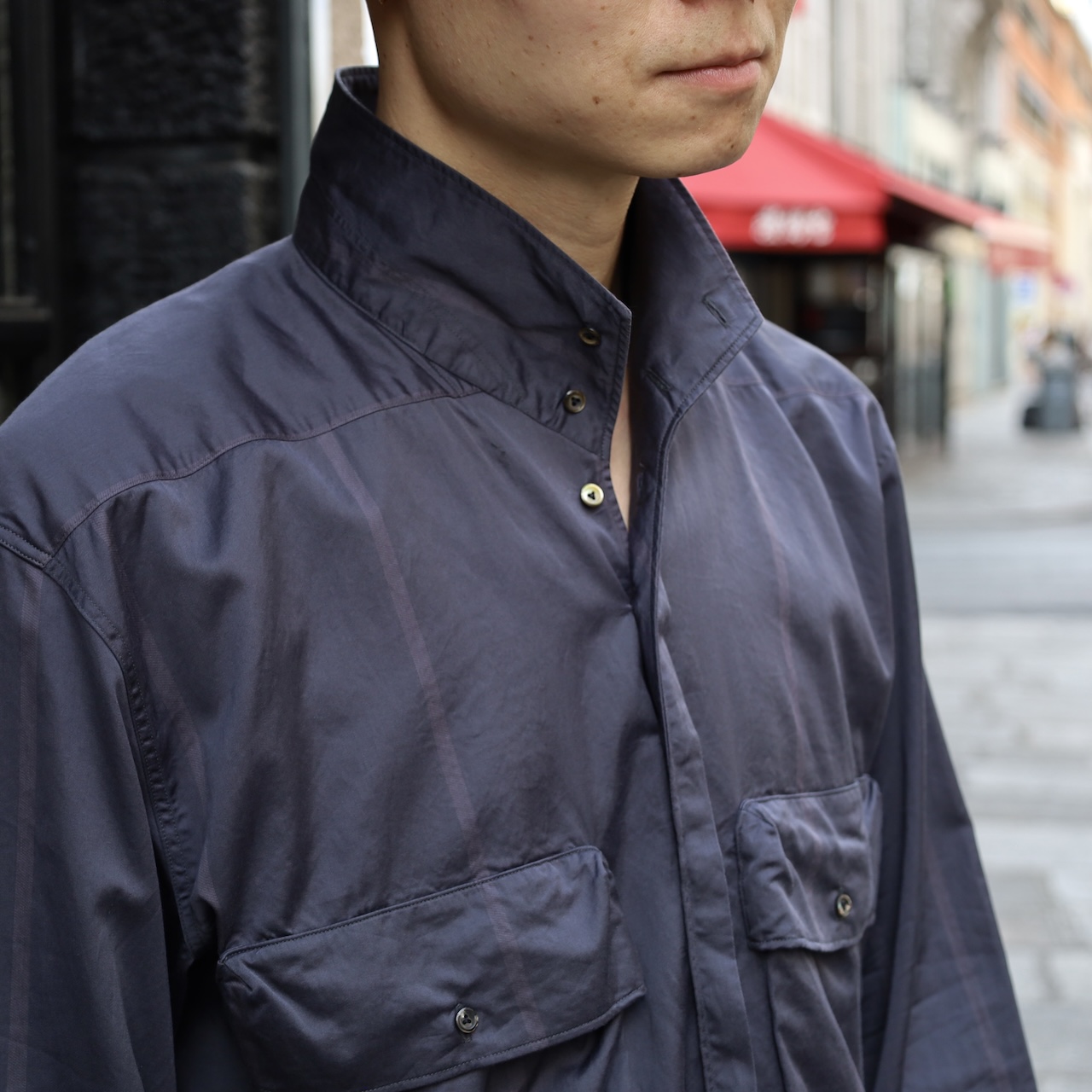
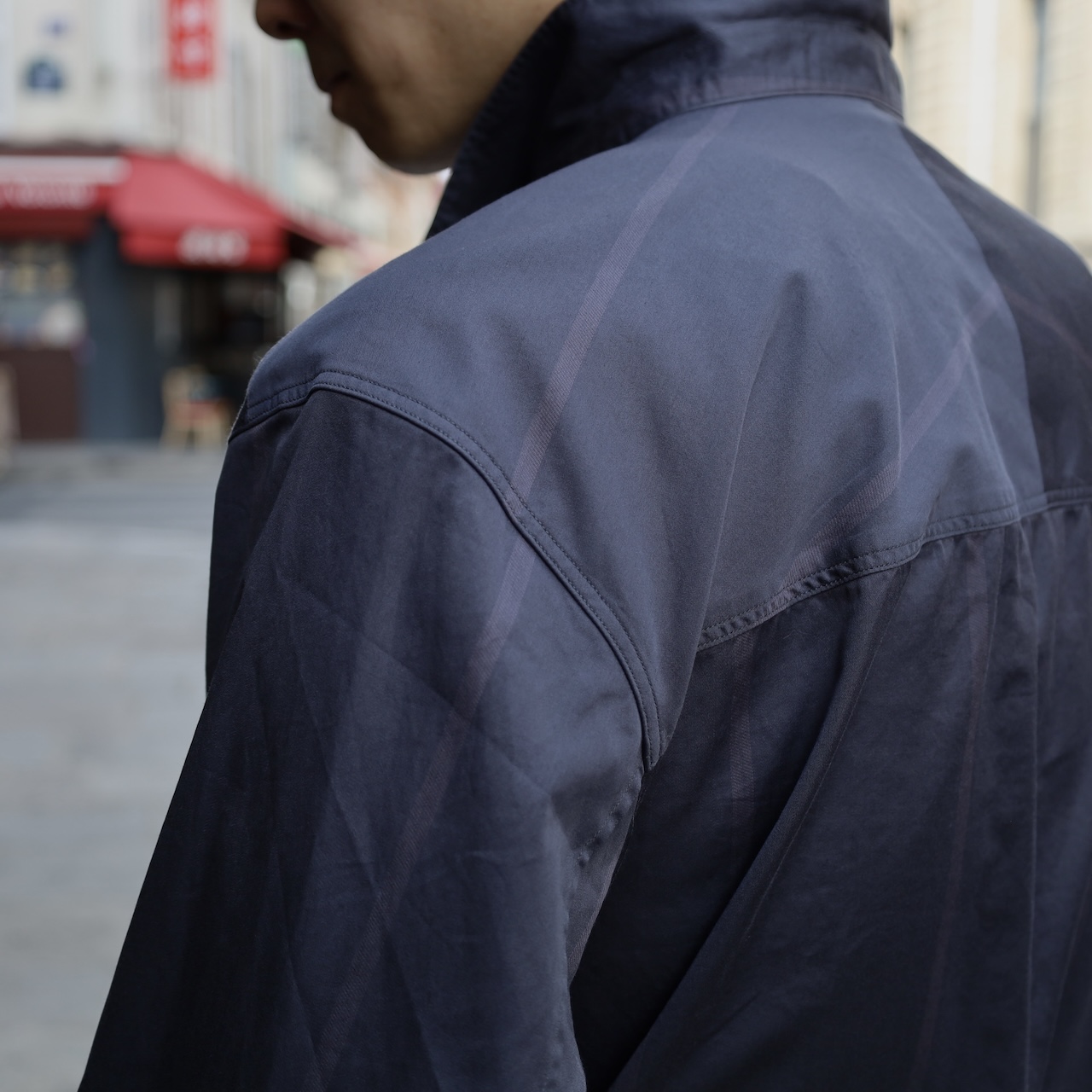
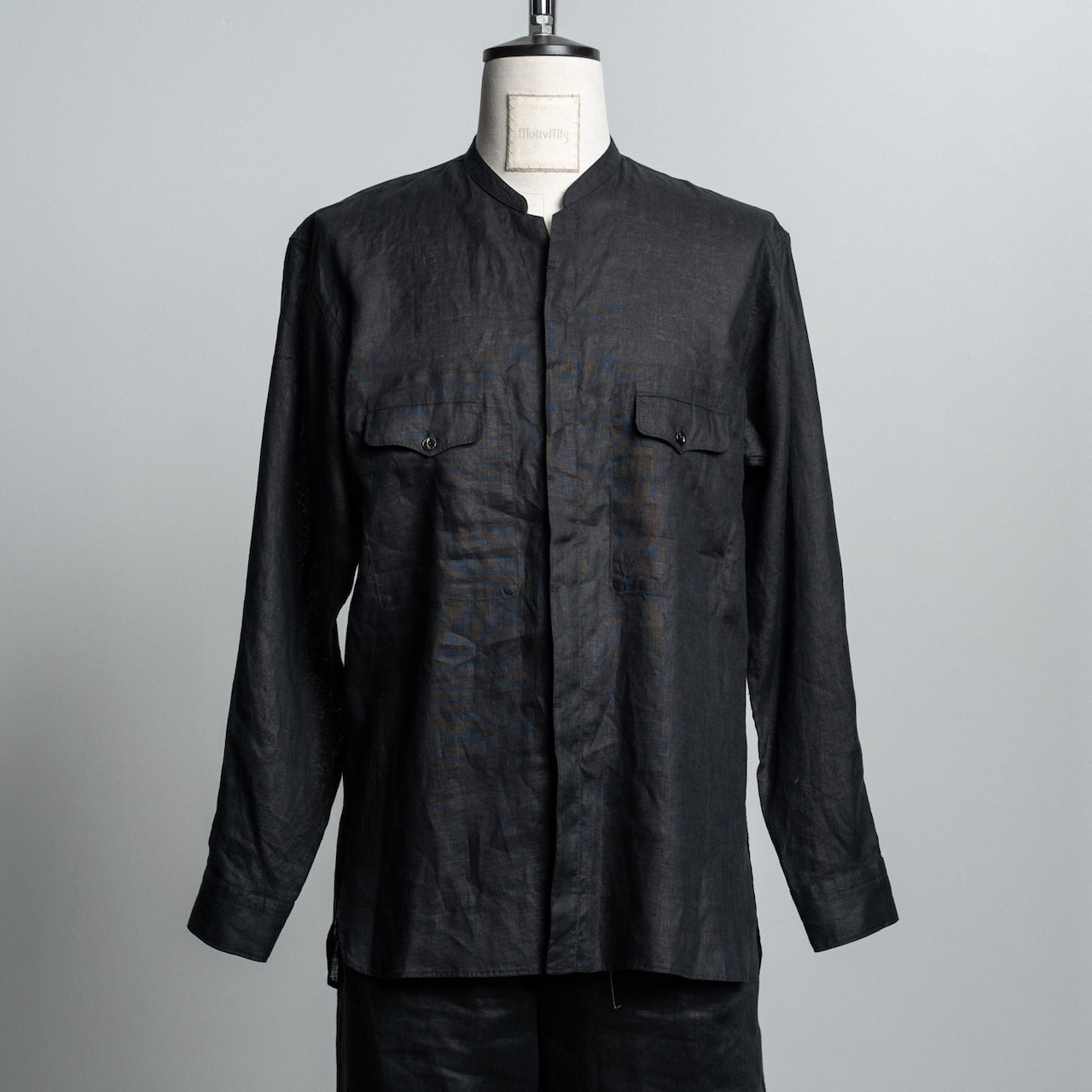
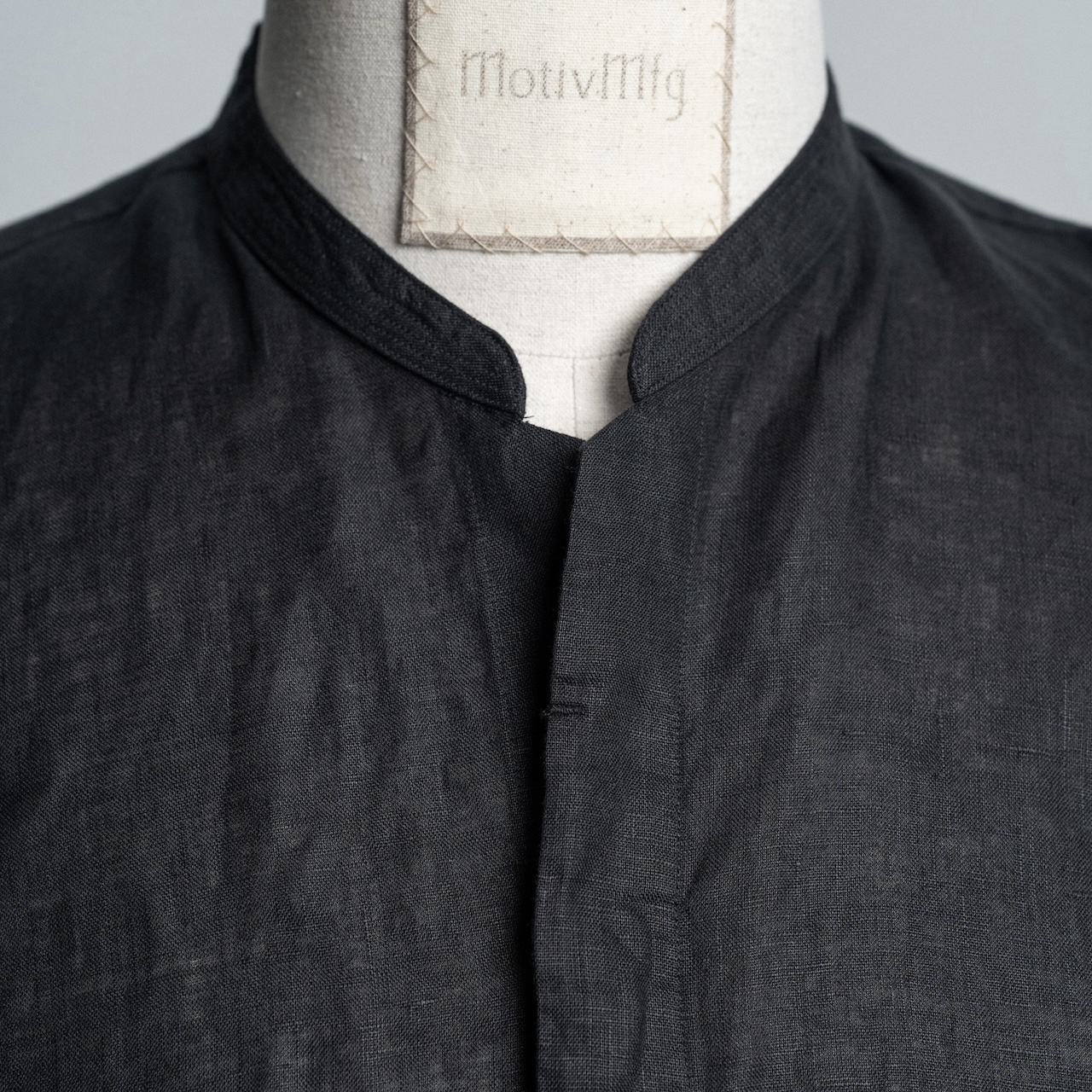
もう一つは、Superfine Irish Linen Shirting。
細番手のリネンならではの柔らかさがあり、繊細なシワと自然な光沢が目を引きます。
特に暑い季節には、自然と手が伸びる生地だと感じました。
トラウザーズにも、テーラーとしての経験を持つDanielさんの感覚が強く反映されています。
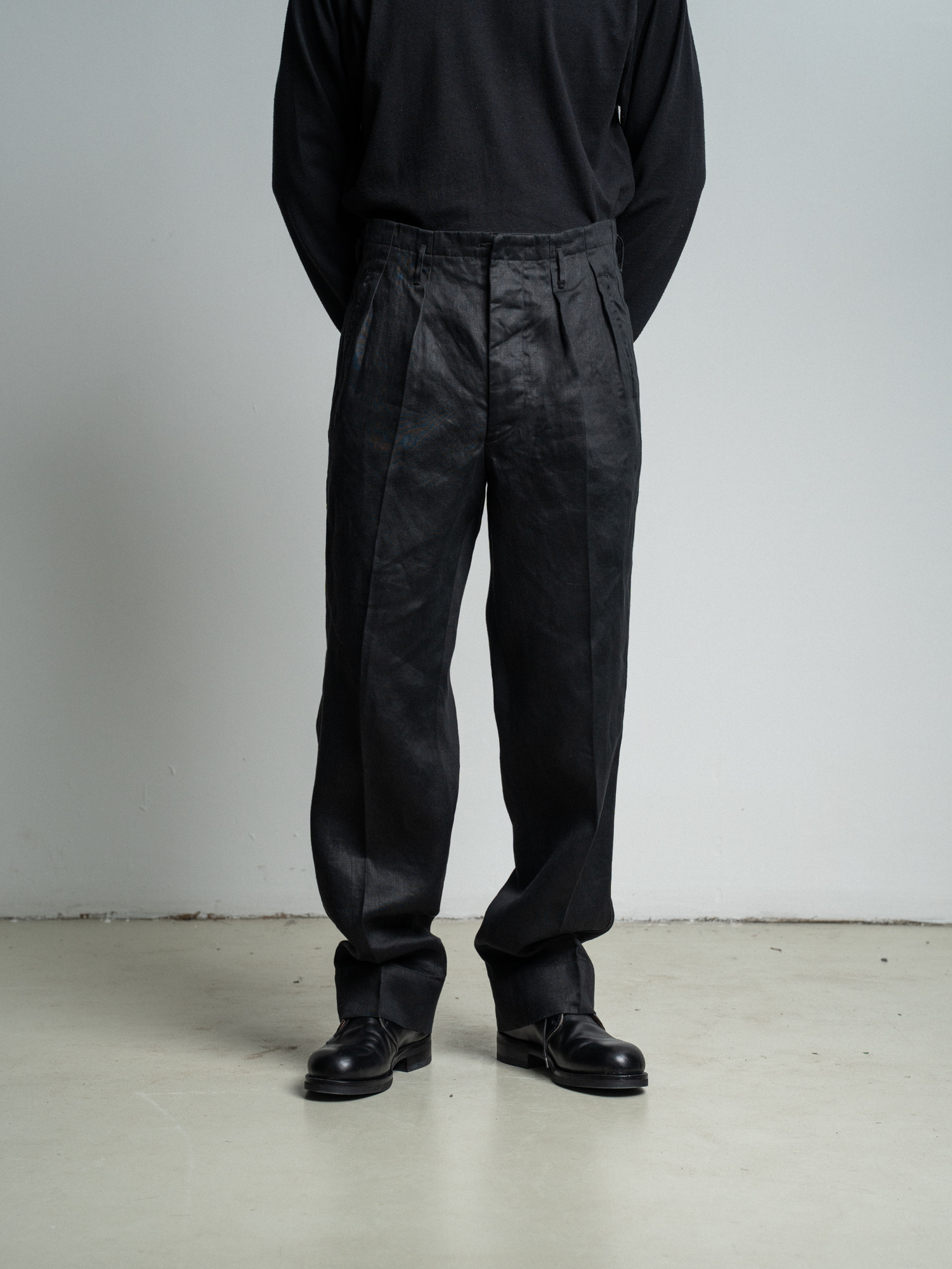
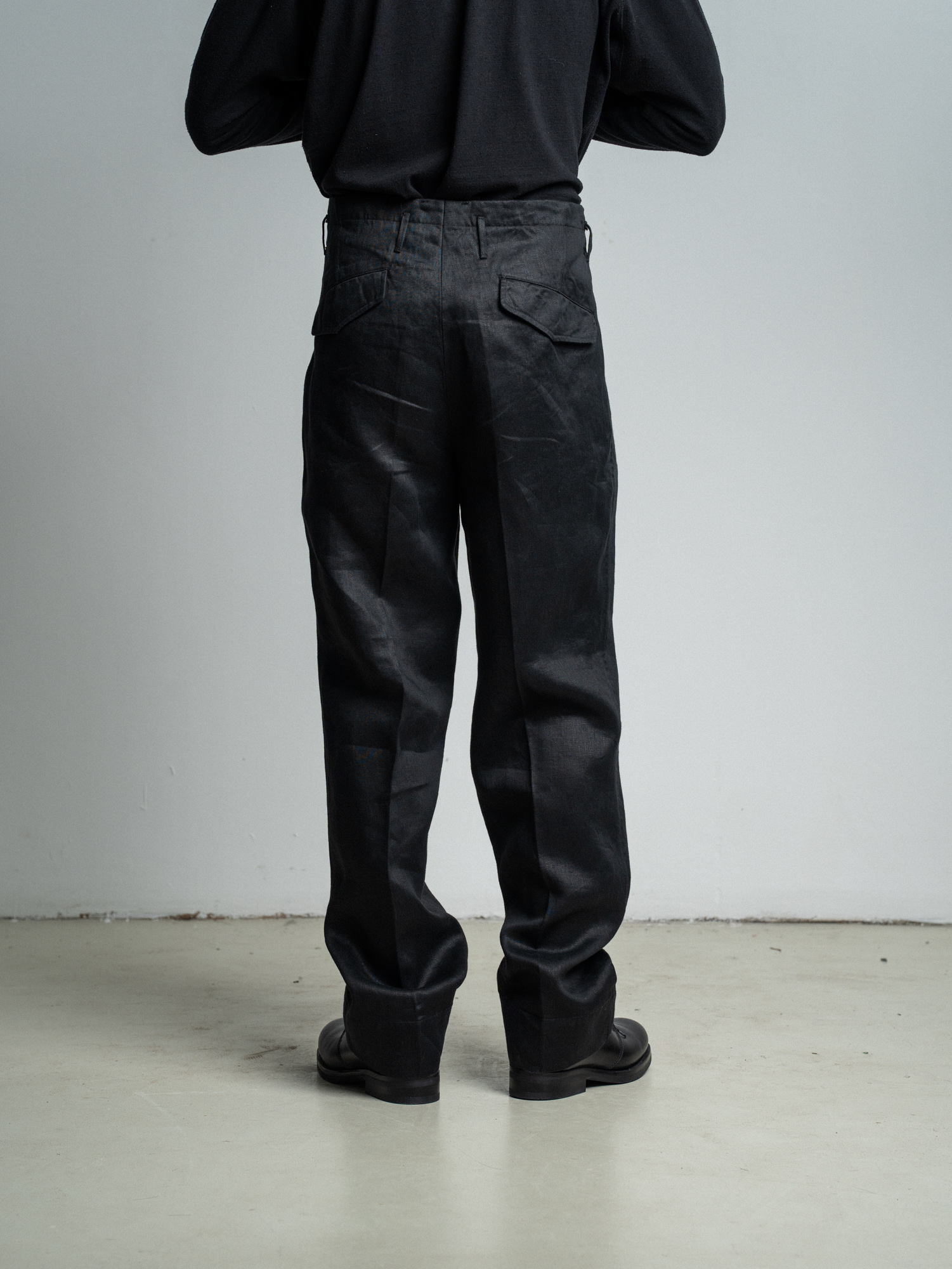
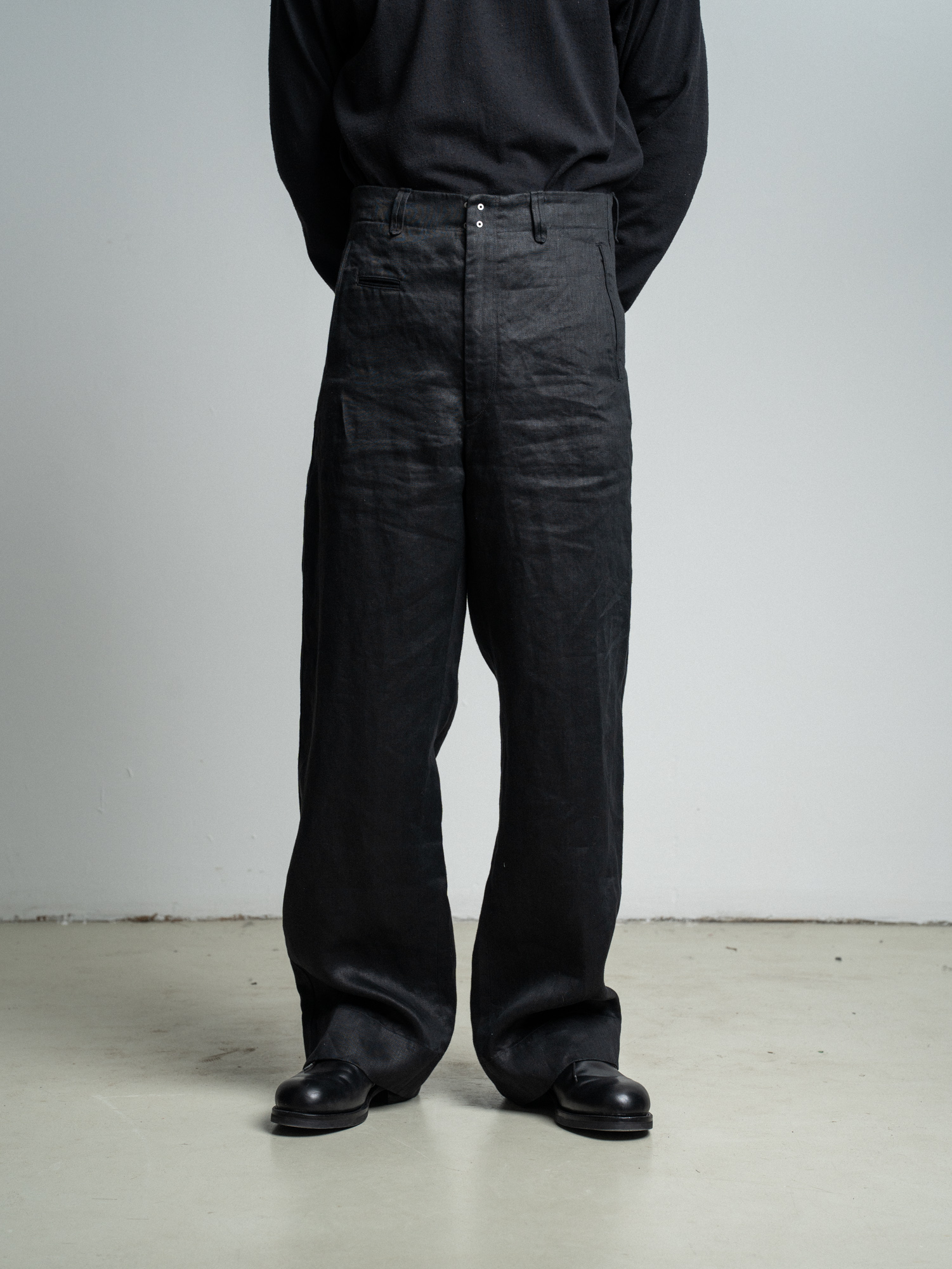
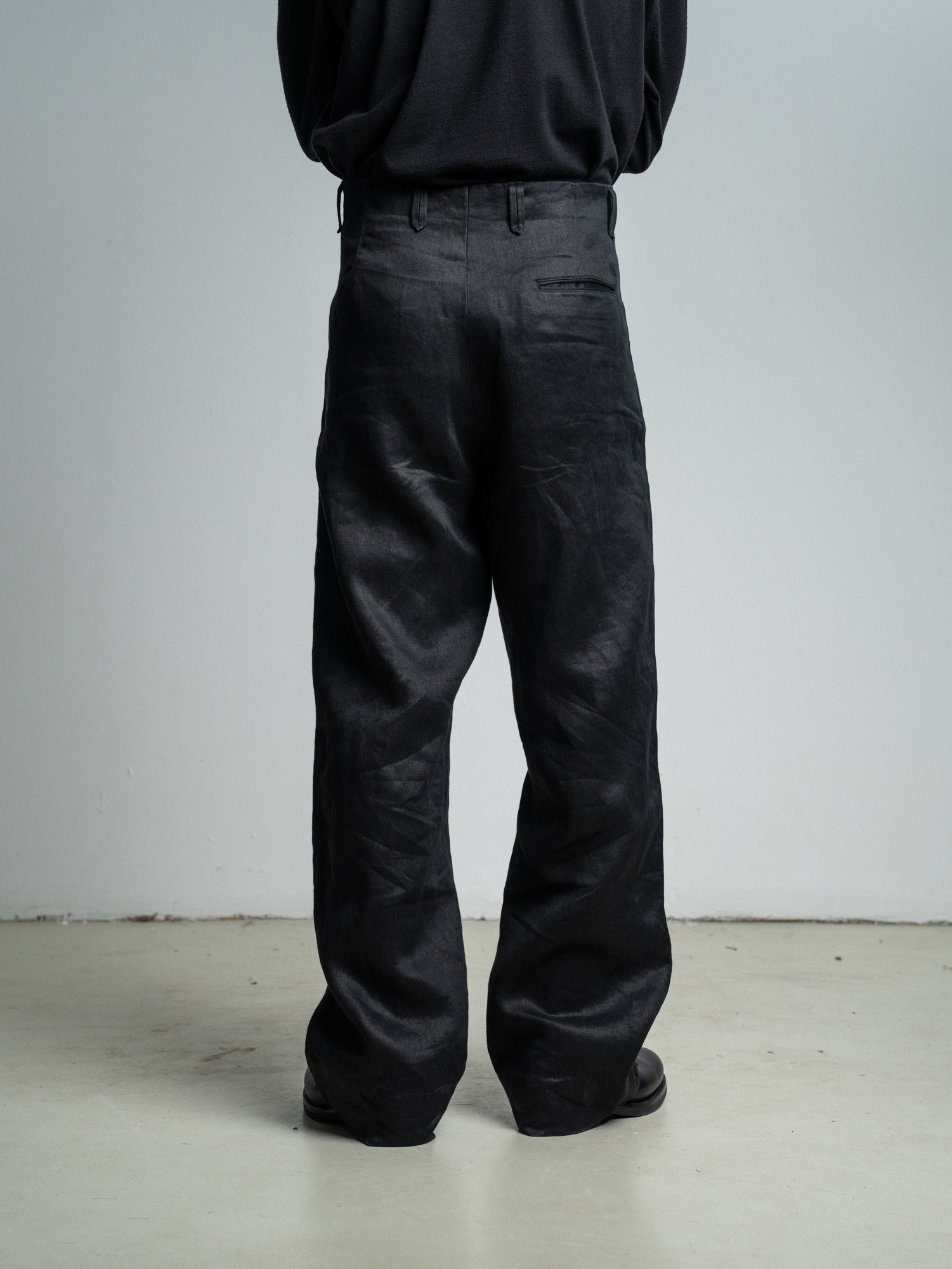
どの位置で身体に沿わせ、どこで生地を身体から離すのか。
腰やヒップ周り、股ぐり、脚のラインに至るまで、単にシルエットという言葉では片付けられないほど、細部まで意識が行き届いています。
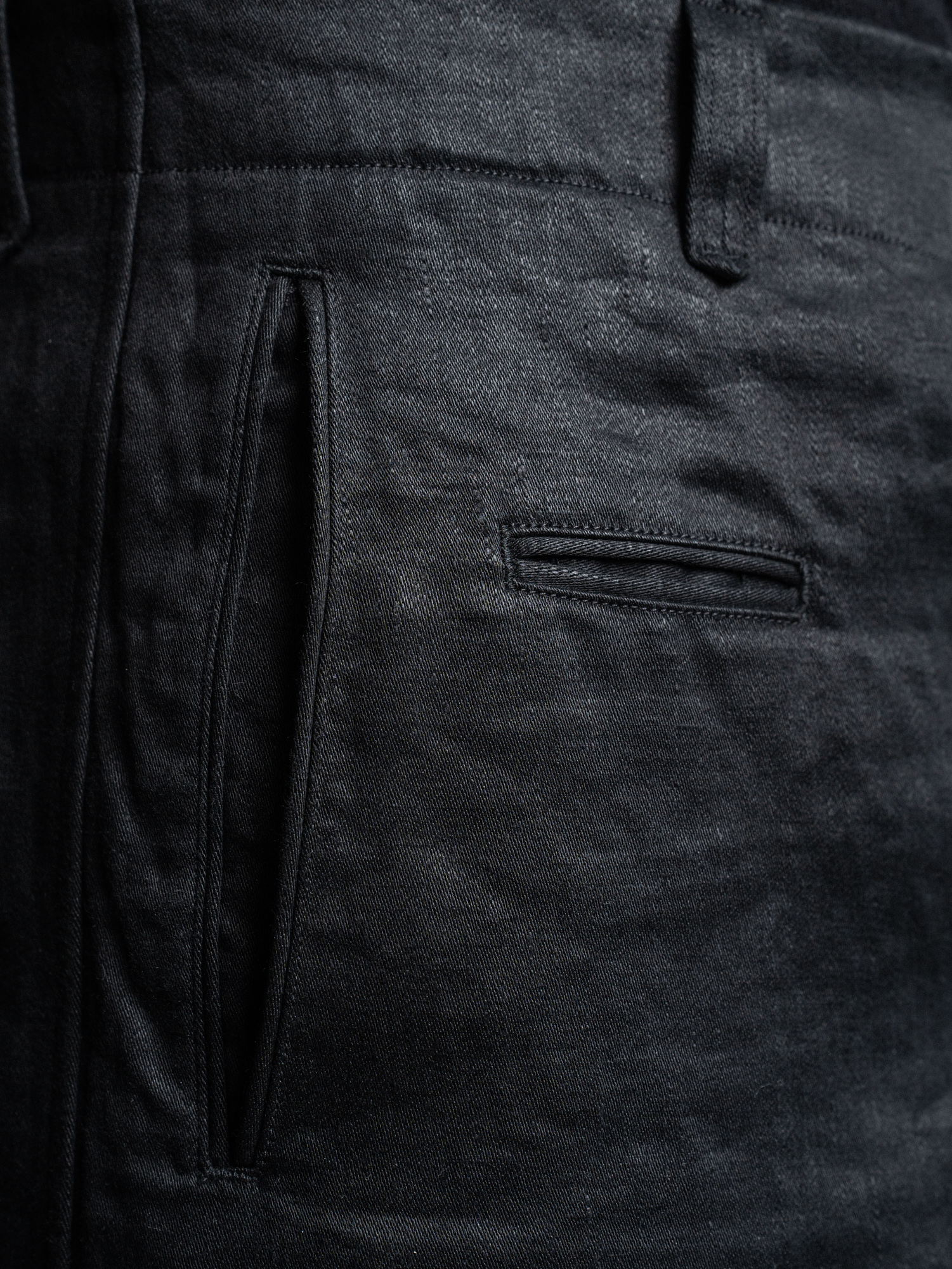
また、そのような意識はシルエット表現だけではなく、ポケットなどのディテールをどう構築するかということにまで及んでいます。
トラウザーズのポケットは、一見すると当たり前のディテールに見えます。
多くの場合、製作上の合理性から、脇線や身頃の切り替えを利用して構築されます。
しかしMotivでは、前身頃に切り込みを入れ、細幅の両玉縁を形成することでポケットを構築しています。
こうした手間のかかる仕様は、効率化が進む中で少しずつ省略されがちです。
それでもMotivは、テーラーとしての視点から、より良いと考えるトラウザーズの形を追求しています。
Motivは、過去の服をなぞるのではなく、過去の制約から未来を想像しているブランドです。
デニム、シャツ、トラウザーズ、テーラードジャケット、テクニカルウェア、レザーウェア。
そのすべてに共通しているのは、服を単なる形として捉えるのではなく、その背景にある技術、構造、思想まで掘り下げようとする姿勢です。
Motivのコレクションを見ていると、普段は見過ごされがちな洋服の歴史的な側面にまで、自然と考えが及んでいきます。
過去の服をそのまま再現するのではなく、その時代の服づくりに存在していた可能性を、現代の洋服としてもう一度つくり上げる。
そこに、このブランドを紹介する大きな意味があると感じています。
LE BERGER
shop talk & communications by Akihiko Fukuda
__________
The English translation is provided below:
Looking at MotivMfg’s denim garments, it becomes clear that they are not simply reproductions of old jeans.
What lies behind them is not merely an admiration for vintage garments as objects, but a regard for an era when workwear was still shaped by the skill and judgement of individual craftspeople.
In this edition of shop talk, we introduce MotivMfg—hereafter referred to as Motiv—which will hold a trade exhibition for buyers in Tokyo this July.
At Motiv, designer Daniel draws on his experience as a tailor to develop every pattern in the collection himself.
Although the brand offers a diverse range of clothing, this article will focus primarily on its denim collection.
The History of Garment-Making Behind the History of Brands
The history of jeans is often told as the history of brands, beginning with Levi’s.
In 1873, Levi Strauss & Co., together with Jacob Davis, secured a patent for reinforcing stress points—such as pockets—with rivets.
From that point onward, Levi’s played a major role in bringing jeans to widespread public attention.
Later, with the emergence of brands such as Lee and, in the years that followed, Wrangler, jeans came to be distributed throughout the United States and established themselves as an industry in their own right.
Yet when the history of jeans and workwear is viewed solely through the evolution of brands and products, something important disappears from view.
That is the history of garment-making itself.
Today, the making of clothes is often discussed within the framework of brands.
In the United States of the past, however, long before brand names were recognised nationwide as they are today, locally rooted clothing merchants, tailors, and small workshops were already making garments for the people who worked in their communities.
Many of those clothes were made and worn locally before eventually disappearing into history.
As a result, very few records remain today—not even the names of those who made them.
And yet, perhaps it was precisely within this form of garment-making, which left no name in history, that the most fundamental character of workwear could be found.
It is this sense of that era that Motiv turns its attention to.
Between Tailoring and Industrial Production
Samuel describes Motiv’s denim construction as being very close to that of denim workwear made between the 1890s and the 1930s.
This was a transitional period in which American workwear was rapidly becoming standardised as an industrial product.
At the same time, local tailors and small workshops continued to operate, and their individual skills, experience, and judgement were reflected in the construction and sewing of the garments they made.
Factory standardisation and the work of individual tailors.
It was a period in which these two approaches existed side by side.
What is important here is that Motiv’s denim should not be understood simply as an extension of traditional American jeans.
Samuel explains that Motiv’s denim is closer not to conventional American jeans, but to an earlier form of European workwear in which tailoring techniques were still deeply embedded.
I believe this is an important point in understanding Motiv.
Although denim is the material, the garments do not simply follow the familiar structure of five-pocket jeans.
Instead, they are constructed as complete pieces of clothing by bringing together tailoring techniques, the structural logic of workwear, and industrial sewing methods.
That approach lies at the heart of the way Motiv has consistently made clothes.
What Motiv looks towards is not simply vintage as an “object.”
It is not a matter of reproducing a surviving garment exactly as it is, but of examining the thinking about garment-making that existed before that garment came into being.
How did local tailors and small workshops conceive of and construct clothing for the workers in front of them, within the limits of the techniques and conditions available at the time?
It is that way of thinking itself that interests Motiv.
Samuel explains that while the sewing techniques used in Motiv’s denim collection are close to those found in old workwear of the period, the pattern cutting is far more complex than that of actual vintage garments.
This complexity is not intended to reproduce the clothing of the past exactly.
Rather, it is imagined from the principle:
“What could have been achieved within the limited technology of the past?”
Or perhaps it could be described as a futuristic interpretation viewed from a very distant past.
Motiv’s denim garments possess this distinctive sense of time.
Rather than tracing the outlines of old clothing, they use the techniques, limitations, and ideas of an earlier era as a starting point for creating contemporary garments.
To see how this philosophy is expressed in the clothes themselves, we will now turn to the denim collection presented at the Paris showroom held in June 2026.
Original Herringbone Denim
The denim collection displayed in the showroom.
One of Motiv’s signature fabrics is its Original Herringbone Denim.
Developed in collaboration with highly skilled selvedge denim weavers in China, the fabric is woven on a specialised dobby loom dating from the 1950s.
According to Samuel, the loom used to weave this selvedge denim is structurally very similar to Japanese Toyoda looms.
Unlike conventional denim, its herringbone construction gives the surface a distinctive sense of texture and depth.
The black warp yarns are sulphur-dyed, allowing the colour to gradually fade with wear, much like indigo denim, while developing greater depth and character over time.
As the fabric is unsanforised, it may shrink by up to 13 per cent.
The finished garments are given a one-wash treatment in advance, helping to reduce substantial shrinkage after purchase.
The herringbone construction is also said to serve a functional purpose beyond its appearance, helping to balance the twisting of the fabric that can occur during washing.
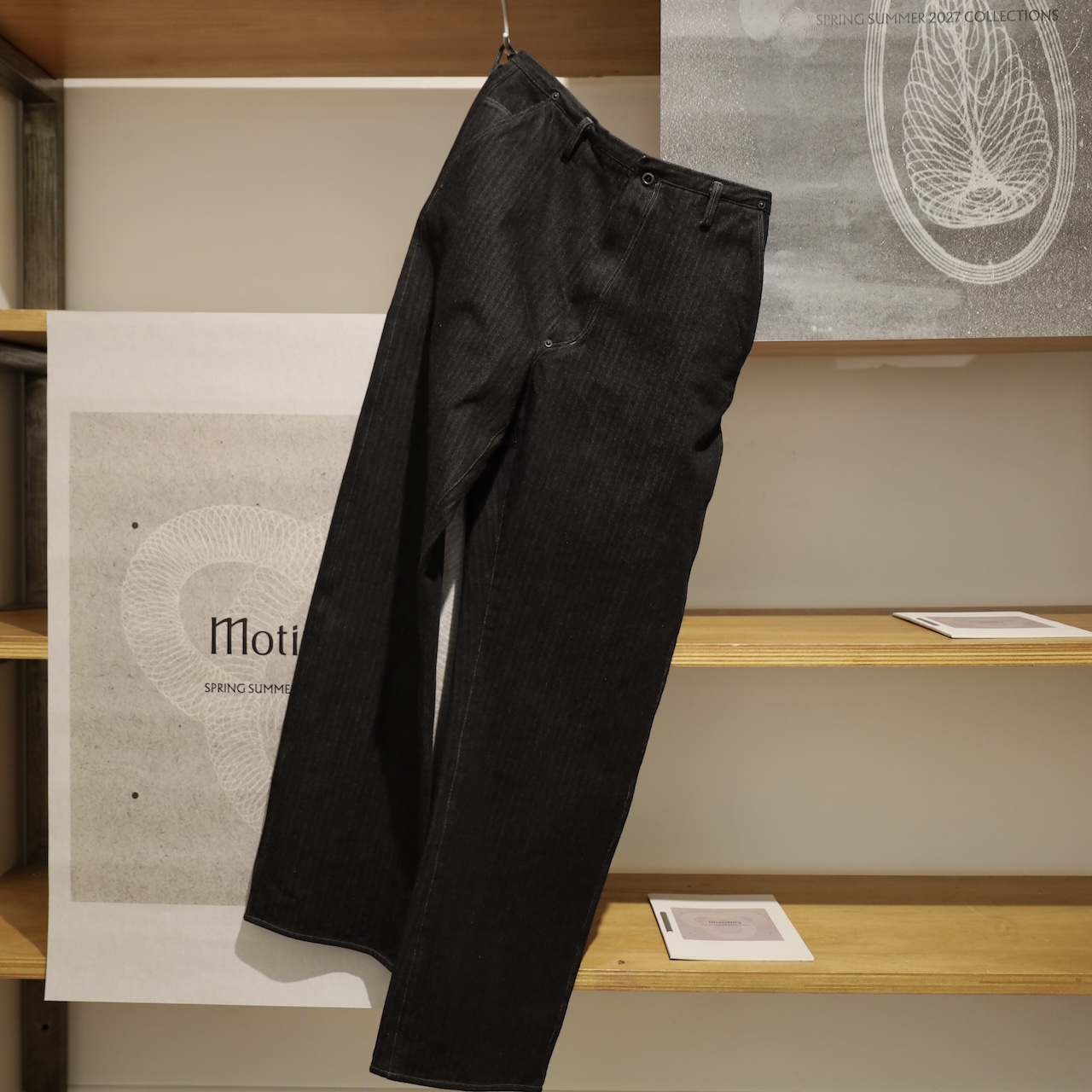
This model is called the Uni Denim Trousers.
The herringbone weave and green selvedge are also distinctive features.
Beyond the fabric itself, the construction details are equally notable, reflecting the techniques, limitations, and ideas of an earlier era.
Looking at Motiv’s denim, I feel that very few denim garments are sewn with this degree of precision and refinement.
Most areas of Motiv’s denim garments are constructed using single-needle lockstitching.
In contemporary mass-produced denim and workwear, flat-felled seams and chainstitching are widely used for reasons of efficiency, strength, and consistency in production.
Motiv, however, deliberately makes extensive use of single-needle lockstitching.
Many denim workwear garments produced between the 1890s and the 1930s were finely sewn using this method.
Single-needle sewing may be technically simple, but it also imposes considerable limitations.
It demands more deliberate decisions about how seam allowances are handled, how layers of fabric are brought together, and where each line of stitching is placed.
Unlike sewing methods developed primarily for efficient mass production, it requires a distinctly craftsmanlike understanding of how to bring an entire garment into being.
I am drawn to this fine stitchwork not only for its visual beauty, but also for the way it lends a sense of definition to the garment as a whole.
Many of Motiv’s woven garments—including its denim, tailoring, and military-inspired pieces—are produced in the brand’s own atelier on the outskirts of Beijing.
The atelier is home to eight highly experienced machinists who once worked as the sample-sewing team at a state-owned factory.
When that factory closed, Motiv brought the entire sampling team into the company, preserving the group intact.
Sample sewing requires far more than simply following a set of specifications. It demands the ability to read the character of a fabric, understand the structure of a garment, and judge its overall level of completion.
The experience and judgement of these craftspeople remain embedded in the construction of Motiv’s clothes.
What Motiv is doing is not simply reproducing garments with the same structure as vintage pieces.
Rather, I believe the brand is attempting to reconstruct, in contemporary clothing, the limitations and decisions that shaped garment-making in the past, along with the possibilities that once existed in the hands of skilled craftspeople.
Even today, when countless denim products already exist, Motiv’s commitment to making clothes in this way within its own atelier gives the brand a clear sense of individuality.
Because its garments depend on the experience and judgement of the people who make them, they are not easily replicated.
Looking at Motiv’s denim collection, denim can be understood not merely as a material or a collection of details, but as a way of considering the ideas and principles through which workwear has historically been made.
Alongside the Original Herringbone Denim, Motiv also develops seasonal denim collections using different fabrics from one season to the next.
A Collection That Extends Beyond Denim
Motiv’s collection extends far beyond denim.
The brand offers a diverse range of garments, from tailored jackets and trousers to shirts, technical outerwear, and leather pieces.
Together, they reveal the breadth of garment-making knowledge and experience that Motiv has accumulated over time.
The shirts are available in a wide variety of fabrics and styles, but two materials in particular left a strong impression on me this season.
The first is the 2-Ply 180s Sateen Shirting.
Woven from two-ply 180-count yarns, the sateen has a remarkably smooth feel against the skin, a finely textured surface, and a subtle lustre.
Despite its broad stripes, it retains an understated elegance without appearing overly assertive.
The second is the Superfine Irish Linen Shirting.
Its fine linen yarn gives the fabric a distinctive softness, while its delicate creasing and natural lustre immediately catch the eye.
It feels like the kind of fabric one would instinctively reach for in the warmer months.
Motiv’s trousers likewise strongly reflect Daniel’s sensibility, shaped by his experience as a tailor.
Where should the garment follow the body, and where should the fabric be allowed to fall away from it?
From the waist and hips to the rise and the line of the leg, every detail has been considered with a degree of precision that cannot be reduced to the word “silhouette” alone.
This attention extends beyond the silhouette itself to the way details such as pockets are constructed.
At first glance, trouser pockets may seem like an entirely ordinary feature.
In many cases, for reasons of production efficiency, they are built into the side seam or incorporated into existing panel lines.
Motiv, however, cuts directly into the front body and constructs the pocket with narrow double welts.
As production becomes increasingly streamlined, labour-intensive details such as these are often gradually eliminated.
Motiv nevertheless continues to pursue what it considers the ideal form of trousers, guided by a tailor’s point of view.
Motiv is a brand that does not simply trace the clothing of the past, but imagines the future through the limitations of the past.
Denim, shirts, trousers, tailored jackets, technical wear, and leatherwear.
What unites them all is an approach that does not treat clothing merely as form, but seeks to examine the techniques, structures, and ideas that lie behind it.
Looking at Motiv’s collection naturally leads us to consider historical aspects of clothing that are often overlooked.
Rather than reproducing the garments of the past exactly as they were, Motiv takes the possibilities that existed within the garment-making of those eras and brings them into being once again as contemporary clothing.
It is here that I find the greatest significance in introducing this brand.